Photo credit: SDOT
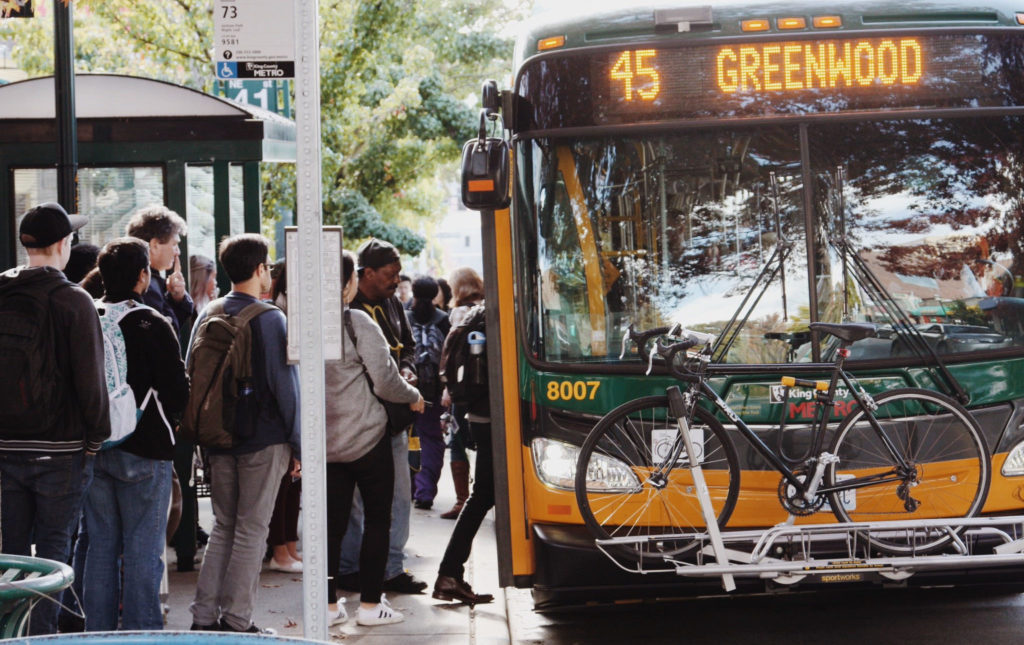
Mayor Katie Wilson has released her proposal to renew the Seattle Transit Measure (STM), and Transportation Choice Coalition is strongly supporting it. Seattle is one of the few big cities in the country that buys additional bus service from its transit agency. That makes buses more frequent, ensuring people have quicker trips to healthcare, grocery stores, and childcare. Mayor Wilson’s proposal doubles down on that investment. The Seattle City Council now has to develop legislation to renew the measure, and if approved, Seattle voters will decide in November. Here is what the Seattle Transit Measure is, why it matters, and what we think needs to happen for it to be as strong as possible.
Plus take Action NOW through our Action Alert telling Seattle City Council: Don’t Shrink the Seattle Transit Measure!
What Is the Seattle Transit Measure?
The Seattle Transit Measure is one of the more direct tools Seattle has for investing in public transit. The measure lets Seattle voters choose to raise local revenue specifically to fund more bus service and other transit-related priorities, such as subsidized ORCA cards and transit infrastructure projects. Anyone who spends money on sales-tax eligible purchases pays a fraction of a percentage extra in sales tax. The City of Seattle collects the money and pays King County Metro, our regional bus operator, to increase service on bus routes serving Seattle. It is a unique funding model enabled by Seattle’s local Transportation Benefit District (TBD). State law restricts how TBD’s, or local transit funding areas, can raise money through sales tax and/or a vehicle license fee.
Seattle has been investing in local transit through ballot measures since 2014, when voters approved the original Seattle Transportation Benefit District Prop 1 with 62% support. The current Seattle Transit Measure passed in 2020 with 80% of the vote. According to the City of Seattle, the measure funds 180,000 additional bus trips per year, with nearly half of those investments directed to equity priority areas in Seattle. It has distributed 52,000 ORCA cards to low-income residents, completed more than 100 transit capital projects, and invested more than $14 million in support for regional transit safety initiatives.
The current measure expires in April 2027. Without renewal, King County Metro will likely need to cut some bus service in Seattle, reduce capital project spending, and eliminate its subsidized ORCA program.
Transit funding is always urgent, but the case for this renewal is especially clear right now. Car ownership in Washington State costs an average of $12,000 per year, and gas prices continue to rise. For many Seattle residents, that financial reality is not new. Transit has always been their primary way of getting around, not a lifestyle choice or a backup plan. They depend on buses to get to work, to medical appointments, to school. They are counting on the city to keep investing in a system that works for them.
The 2026 Seattle Transit Measure Proposal
Building on the 2020 Transit Measure, Mayor Katie Wilson has proposed a 0.3% sales tax over 10 years, expected to generate an average of $138 million annually. This replaces the current 0.15% tax and is estimated to cost the median two-person Seattle household about $58 per year, compared to $29 per year under the current measure.
The funding would be allocated as follows:
- 86% ($116 million) toward transit service, including $96.1 million for bus service and $25 million per year to fund Seattle Streetcar operations and maintenance
- 7% ($9.6 million) toward transit access passes
- 4.5% ($6.1 million) toward Sound Transit 3 project planning and delivery support
- 2.5% ($3.5 million) toward capital improvements at bus stops and transit corridors
More Bus Service
The most significant investment is in service hours. The proposal adds 100,000 annual service hours on top of what the current measure funds, bringing Seattle to 89% completion of its Frequent Transit Network, with every funded route connecting to at least one light rail stop. According to The Urbanist, this would restore Seattle bus service to pre-pandemic levels, but structured differently, with a stronger emphasis on all-day frequency rather than peak commuter service, reflecting how ridership patterns have shifted since 2019.
Seattle Streetcar
The measure also funds operations and maintenance of Seattle’s two streetcar lines, the First Hill Line and the South Lake Union Line, both of which are operated by King County Metro but funded by the city. Combined ridership reached 1.6 million trips in 2025. The First Hill line has returned to its 2019 ridership levels, and the South Lake Union line grew by 40,000 riders, a 26% increase, over the same period. Both lines serve a higher than average share of zero-vehicle households and people of color.
Expanded Fare Subsidies
The renewal also expands the Transit Access Pass program to 22,000 people, an increase of 12,000 over current funding levels. It extends eligibility to all Seattle Housing Authority (SHA) housing choice voucher holders. A subsidized ORCA card saves a rider roughly $1,200 per year in transit costs and more than $12,000 per year compared to owning a car. In 2022, the SHA Transit Pass Program generated nearly 2.5 million rides and saved participants over $4.75 million in fares. Expanding this program is a meaningful step toward making Seattle genuinely accessible to people of all income levels.
Capital Improvements
A smaller share of funding, about $3.5 million per year, goes toward targeted capital improvements, which could include bus lanes, signal changes, stop shelters, lighting, and other infrastructure that speeds up service and makes it safer and more comfortable to access.
Sound Transit 3 Planning & Support to Build Graham Street
About $6.1 million per year goes toward supporting Seattle’s role in delivering Sound Transit 3 projects, including the West Seattle Link Extension, the Ballard Link Extension, and the Graham Street Station. This money pays for city staff working on project management, planning, engineering, permitting, and environmental review, as well as planning for the streets, crosswalks, bus stops, and bike lanes that will connect riders to the new stations. It is an investment in making sure that when the trains arrive, the rest of the network is ready to meet them.
TCC’s Priorities for a Strong Seattle Transit Measure
Transportation Choice Coalition has been advocating for transit riders in Washington State for 34 years, and we have been proud to help fund and campaign for past Seattle transit measures, including the 2020 Seattle Transit Measure and the 2024 Seattle Transportation Levy. We support Mayor Wilson’s proposal and will work to pass it in November. We also have the following priorities we will be pushing throughout the Council process.
Send a .3%, 10-year measure to Seattle voters. The City Council should pass this measure at the full 0.3% sales tax rate for the full 10-year term and send it to voters without cutting the size or duration. Reducing the tax rate or shortening the measure’s lifespan could mean fewer service hours, fewer ORCA cards, and a weaker network. The mayor’s proposal reflects what it actually costs to run and expand transit in Seattle, and we will be pushing hard to keep it intact.
Service hours must be protected. Maintaining current service levels should be a guaranteed floor regardless of rising operator and maintenance costs. The additional hours are what make this measure worth fighting for, and they should not be traded away for other priorities.
Capital dollars should serve riders directly. We support targeted improvements that speed up buses, ensuring the money we spend doesn’t go to buses stuck in traff. Metro already receives dedicated safety funding through the hours the City of Seattle buys with Seattle Transit Measure funding, as well as through the Seattle Transportation Levy. The 2024 Transportation Levy dedicates $160.5 million to Vision Zero and safety improvements and $193 million to pedestrian safety over eight years, including $9 million specifically for transit rider safety. STM capital funds should stay focused on bus lanes, signal improvements, and stop access projects that keep buses moving and allow us to get more bus service out of the dollars we spend.
The Streetcar needs a plan. At $25 million per year, Streetcar operations and maintenance represent more than a quarter of the total transit service budget. The City should present a concrete plan to demonstrate that investment is warranted and that ridership will grow over the life of the measure.
Sales Tax Is an Imperfect Tool, but the Alternative is Worse
Sales tax is the funding mechanism Washington State law authorizes cities to use for local transit measures, and the property tax cap limits what is achievable through other channels. We know sales tax places a proportionally higher burden on lower-income households. But the most regressive thing a city can do is force people to own a car.
For comparison, the measure will cost the median Seattle household about $58 per year, or $2 per person per month. Put another way, that is roughly one tank of gas or one year of a streaming service per household. Per person, it’s one transit pass and less than one cup of coffee. For that, Seattle gets a network that saves riders thousands of dollars and gives people a real way to get around without a car. Car ownership costs the average Washington household over $12,000 per year. A frequent, affordable transit network is one of the most powerful tools we have to give people the freedom to move around their city without that expense.
What’s Next
Mayor Wilson shared her proposal with the City Council on June 4. Over the next several weeks, the Council will discuss, amend, and finalize the legislation before sending it to voters in November. The public has several opportunities to weigh in.
Key dates to know:
- June 18, 2026 at 9:30 AM: Select Committee hearing where Chair Rob Saka will release his proposed transit measure ordinance
- July 6, 2026 at 2:00 PM: Select Committee hearing where amendments to the proposal will be introduced
- July 13, 2026 at 9:30 AM: Public hearing (remote only)
- July 13, 2026 at 5:00 PM: Public hearing
- July 16, 2026 at 9:30 AM: Select Committee hearing where the committee can vote to pass the measure for full City Council consideration
- July 21, 2026 at 2:00 PM: Full City Council meeting where the measure will have its final vote
Take Action Now!
Sign up for action alerts and more information. TCC will be sharing actions you can take to support the Seattle Transit Measure through our email list. Sign up here to stay up to date.
Show up on Thursday, June 18 at 9am. The Select Committee hearing on June 18 is an critical chance for the public to speak directly to councilmembers on the day Chair Saka releases his version of the ordinance. We need riders, advocates, and transit supporters in that room telling the Council to pass the mayor’s proposal in full. You can testify in person or virtually. The address is City Hall, 600 4th Avenue, Council Chambers. We encourage you to show up at 9am to sign up for comment. The meeting begins at 9:30am.
Send a letter right now. It takes two minutes and it matters. Use our action alert to tell the Seattle City Council to put the full Seattle Transit Measure on the ballot: Tell Seattle City Council: Don’t shrink the Seattle Transit Measure
Seattle has voted for transit over and over again. Let’s make sure what goes on the ballot in November is a measure worth voting for.