
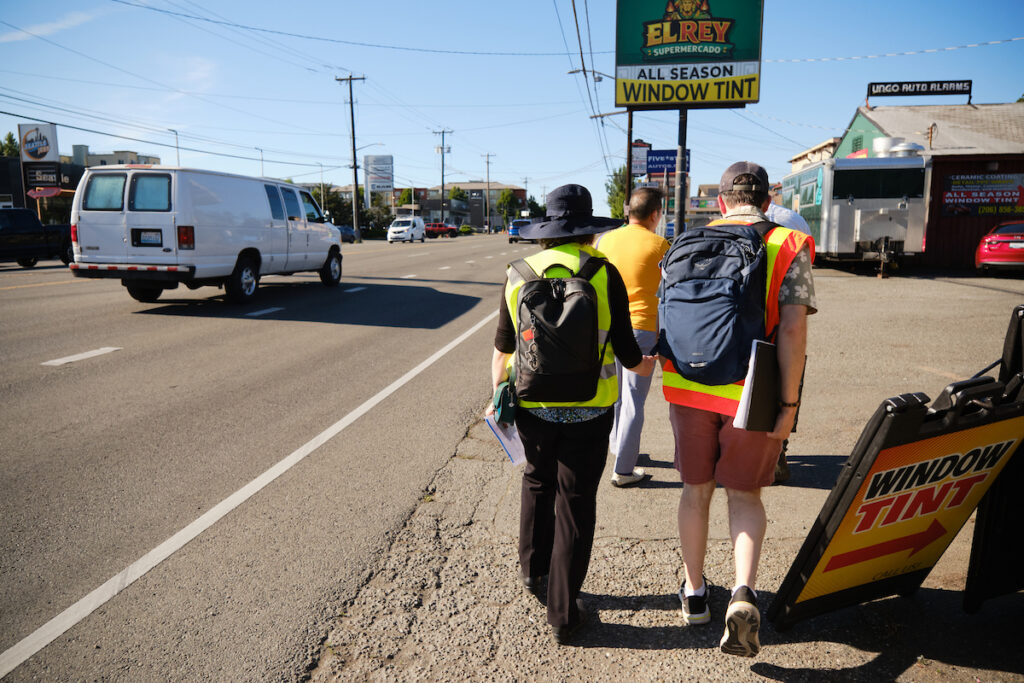
Photo by Danny Ngan Photograhy
On June 2, Transportation Choices Coalition, in partnership with the Aurora Reimagined Coalition, hosted a Megaproject for Safety Walk & Talk along Aurora Avenue in Seattle’s Bitter Lake neighborhood. Aurora is one of Washington’s busiest but most notorious urban corridors. The Walk & Talk was the second in our series of events across the state that focus on state-owned roads that run through dense, growing areas. This event was generously supported by our sponsors, The Vida Agency and Maul Foster & Alongi.
TCC hosts these Walk & Talks in support of our Megaproject for Safety, a statewide initiative to transform Washington’s most dangerous state-owned main street highways into safer, more accessible corridors for people walking, rolling, biking, and taking transit. In 2025, the state legislature approved $100 million in funding for the Megaproject, but we will need billions of dollars of state investment to meet the scale of the challenge. The Walk & Talks help keep momentum going, by elevating community voices, raising public awareness, and strengthening support among decision-makers to fund and implement needed changes.
In 2025, TCC kicked off the series with an event along Division Street in Spokane. This time, we brought together over 30 elected officials, state and city policymakers, local advocates, and community members to walk a mile-long route on Aurora Ave between 128th and 137th Streets in the Bitter Lake neighborhood and experience what it’s like to move along the street’s sidewalks (or lack thereof).
Why Aurora Ave?
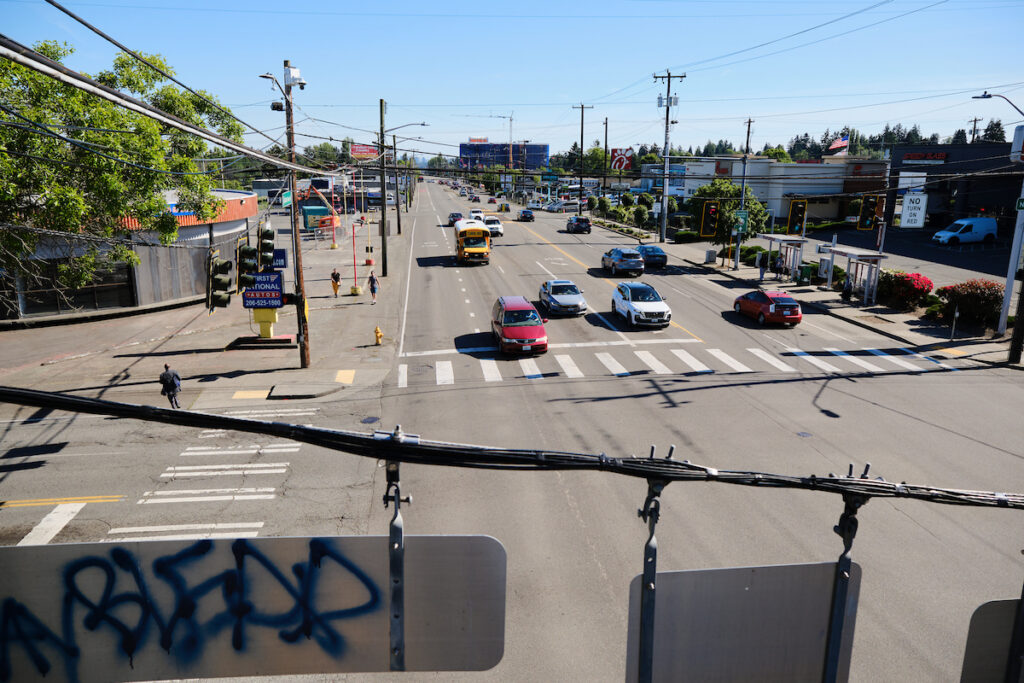
Looking down from a pedestrian overpass on Aurora. Photo by Danny Ngan Photography
Aurora Avenue North (SR 99) carries the region’s highest-ridership bus, the RapidRide E Line operated by King County Metro. Aurora passes through multiple growth centers, including Fremont, Wallingford, Greenwood, and Bitter Lake, where Seattle plans additional housing, jobs, and amenities. Most trips along the corridor are short and local, highlighting the need for safe crossings, reliable transit access, and infrastructure that serves everyday community use.
Yet Aurora remains one of Seattle’s most dangerous corridors. Like many state-owned highways across Washington, it was designed decades ago as a six- to seven-lane high-speed roadway to move cars efficiently through dense city centers. As cities grew, these roads became neighborhood hubs lined with dense housing, transit routes, small businesses, schools, and jobs. Today, roads like Aurora Ave divide neighborhoods and create barriers for pedestrians, cyclists, and transit users, with many segments lacking continuous sidewalks. And despite their central role, these highways remain some of the deadliest places for people walking and biking. In 2023, nearly half of pedestrian fatalities in Washington occurred on these state-owned main street highways.
According to SDOT’s corridor study, the 7.6-mile Aurora corridor accounted for 17 percent of all traffic fatalities citywide between 2015 and 2019, making it Seattle’s deadliest street. For example, in 2023, two people were killed and at least 160 injured on Aurora, 15 of them seriously. The danger falls disproportionately on people on foot. Pedestrians were involved in 5 percent of collisions on Aurora but accounted for half of all deaths, and 88 percent of those pedestrian fatalities happened between intersections, where signalized crossings are often a half mile or more apart.
This Walk & Talk focused on the Bitter Lake neighborhood stretch on the north end of Aurora in Seattle. Aurora Reimagined Coalition describes this stretch as the most diverse and deadliest section of the corridor. The apartments here are home to seniors, families with kids at neighborhood schools, and speakers of at least 25 different languages, and the street is lined with grocery stores, restaurants, and other local businesses. Portions of Aurora here, including a stretch between N 128th and N 130th and N 135th and 137th Streets, have no sidewalks at all, and signalized crossings are few and far between. Four people were killed on Aurora between N 125th and N 141st Streets in three years.
Aurora exemplifies both the cost of inaction and the potential of bold redesign. With the right partnerships and sustained investment, the corridor can evolve from a high-speed barrier into a connected, neighborhood-serving spine supporting safe mobility for everyone.
What We Learned
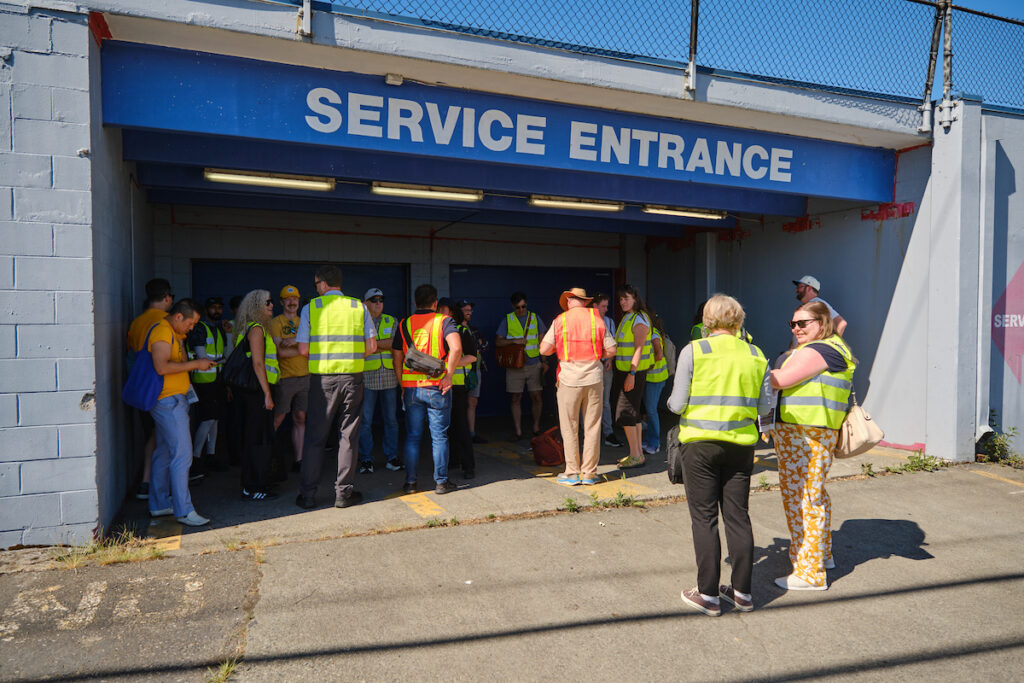
Taking cover from the hot sun under a service entrance to a parking garage. Photo by Danny Ngan Photography
The walk moved north from N 128th Street to N 137th Street, with stops focused on how people actually experience Aurora day to day and highlighted different barriers they face. The topics we experienced and talked about included walking where sidewalks disappear, crossing a wide highway, reaching the E Line, getting to school, accessing services, and planning for future growth.
Attendees heard from community volunteers with Aurora Reimagined Coalition, local high school students, social service providers, Seattle Public Utilities staff, and state legislators, including Rep. Jake Fey and Sen. Marko Liias, chairs of the House and Senate transportation committees. The route served as a field visit and listening session, grounding TCC’s statewide Main Street Highways advocacy in firsthand observations and community experience along Aurora.
Here are a few themes that stood out:
Small fixes help, but Aurora needs a full redesign
At N 128th Street, recent turn restrictions and low-cost pedestrian and bike improvements are helping reduce cut-through traffic and improve east-west connections toward the upcoming Pinehurst Station. Walk attendees saw the fixes in practice and talked about their limitations. While we saw one area of minor street improvement, we actively watched people cross areas of the street with small medians and no crosswalks. We walked multiple sections that didn’t even have sidewalks. Six lanes of traffic zoomed by. A pedestrian bridge over Aurora at N 130th was inaccessible to wheelchair users, as was a staircase from a RapidRide E bus stop to the adjacent parking lot. The length and decades long poor design of Aurora mean it needs a full corridor redesign, not just isolated improvements.
The walk to transit is part of the transit trip
The walk highlighted that safety design and transit reliability are inseparable. Aurora carries the RapidRide E Line, the city’s busiest bus route. RapidRide stops are spaced farther apart than regular bus stops. So, reaching a stop means people have to travel farther distances, often several very long blocks. Along the way, they must navigate missing sidewalks, open driveways from commercial parking lots, and crossings timed more for moving traffic than for people, which can feel like a sprint for seniors and people with mobility challenges. Residents described planning errands around intersections with longer walk times, taking the bus just one block because crossing Aurora on foot was too difficult, and the danger experienced when sidewalks disappear, including an account of a resident being struck by a bus while walking along the shoulder on the corridor.
Students attending nearby schools described their routes mixed with heavy truck traffic with missing sidewalks, leading some families to drive trips of just a few blocks. They also raised security concerns on and around the E Line and at bus stops, underscoring that a safe transit trip depends on both street design and the conditions people experience while waiting for and riding the bus.
Access to services is a safety issue
Aurora divides destinations that should feel close. The corridor concentrates both the services people depend on and the danger in reaching them. The soon-to-be-opened Pinehurst Light Rail Station, North Helpline’s Bitter Lake food bank, Bitter Lake Community Center, nearby senior and family housing, schools, supportive housing, and other everyday services like grocery stores draw people across and along Aurora daily. Many of the people these destinations serve travel by bus, on foot, or with mobility devices. Service providers and community members made clear that the existing street environment has become a barrier to care, housing, food, and daily errands. Access to services on Aurora must be treated as part of the safety project.
A redesign can fix more than traffic
Rebuilding Aurora is also a long-term infrastructure opportunity. Near N 137th, the discussion connected future street work to drainage and stormwater. Seattle Public Utilities highlighted that stormwater from the corridor ultimately drains toward Lake Union, and that reconfiguring Aurora creates a chance to pair safety improvements with stormwater infrastructure built for the next century.
The weather on the day made a related point. It was a hot June afternoon (over 80 degrees), so the group repeatedly sought shade in places such as parking garages because the street has so few trees. Street trees, stormwater infrastructure, safer crossings, and better transit access should not be separate projects on corridors like Aurora. They are all part of one corridor redesign. That scale of change takes state-level investment, which is exactly what the Megaproject for Safety is calling for.
Relevance to the Megaproject for Safety
Aurora shows why our statewide Megaproject for Safety advocacy matters. Aurora is a state-owned Main Street Highway still shaped by 80-year-old highway-era design, even as it functions as a neighborhood street, transit corridor, business district, and access route to homes, schools, and services. The Walk & Talk made this tension visible. State leaders and agency staff stood where sidewalks disappeared, saw the challenge of crossing Aurora, heard what it takes to reach bus stops, and saw how challenges of transportation, housing, drainage, and social services overlap on one corridor.
Walk & Talks are valuable because they turn policy decisions into lived experience, give legislators, agencies, advocates, and community partners a shared understanding of current conditions, and help build urgency for appropriate policy and funding solutions.
Legislative Context
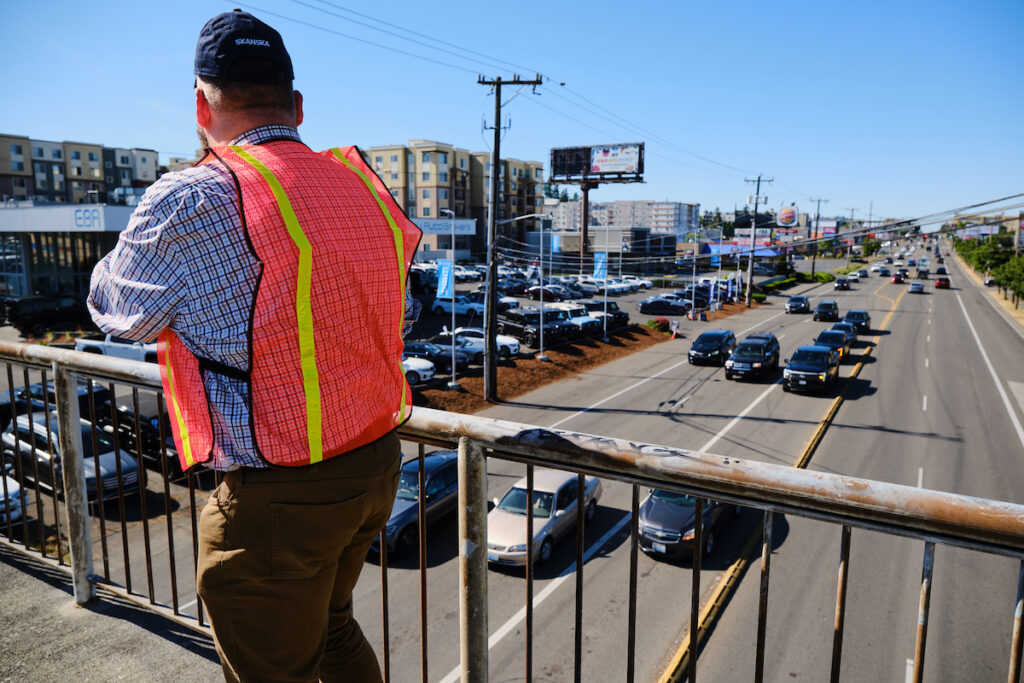
Looking down on Aurora from a pedestrian overpass. Photo by Danny Ngan Photography
The Aurora Walk & Talk came at an important moment for statewide transportation funding. In 2025, TCC and partners helped secure an initial $100 million for safety investments beginning in the 2027-29 biennium. In 2026, TCC helped secure $250,000 for WSDOT to develop a comprehensive plan for redesigning Washington’s most dangerous state-owned Main Street Highways. TCC is calling for $2 billion over 10 years to transform the most dangerous Main Street Highways statewide. Legislators also highlighted the importance of the state’s Complete Streets mandate, which ensures eligible WSDOT projects think beyond vehicle movement and design for people walking, rolling, biking, and riding transit.
Next Steps
There are clear, straightforward priorities to improve corridors like Aurora: safer walking, rolling, biking, and transit access; stronger connections to schools, housing, businesses, and services; improved accessibility; and investments that address climate resilience, drainage, and green infrastructure at the same time. Corridors with this many overlapping needs require a comprehensive approach. These priorities and approach will inform TCC’s continued advocacy with state legislators, WSDOT, and other local partners.
The Walk & Talk also reinforced the importance of local partnership. Groups like Aurora Reimagined Coalition and Spokane Reimagined bring deep local knowledge and community-rooted visions for safer, more accessible, more resilient streets. Paired with TCC’s statewide advocacy and leadership, this momentum can help turn corridor needs into funding and implementation.
TCC will continue hosting Walk & Talks on Main Street Highways across Washington to document conditions, elevate community voices, and build support for the next phase of advocacy for Megaproject for Safety. These efforts will help move state highways toward safer, more accessible Main Streets for the people and communities they serve.
Stay Engaged With Our Megaproject for Safety Work!
- Sign up for our email newsletter to find out about future Walk & Talks, events, and advocacy opportunities.
- Learn more about TCC’s Megaproject for Safety.
- Read about our first Walk & Talk on Division Ave in Spokane last July.
- Interested in hosting a Walk & Talk in your town? Contact Iz Berrang, Education and Engagement Manager, at Elizabeth@transportationchoices.org