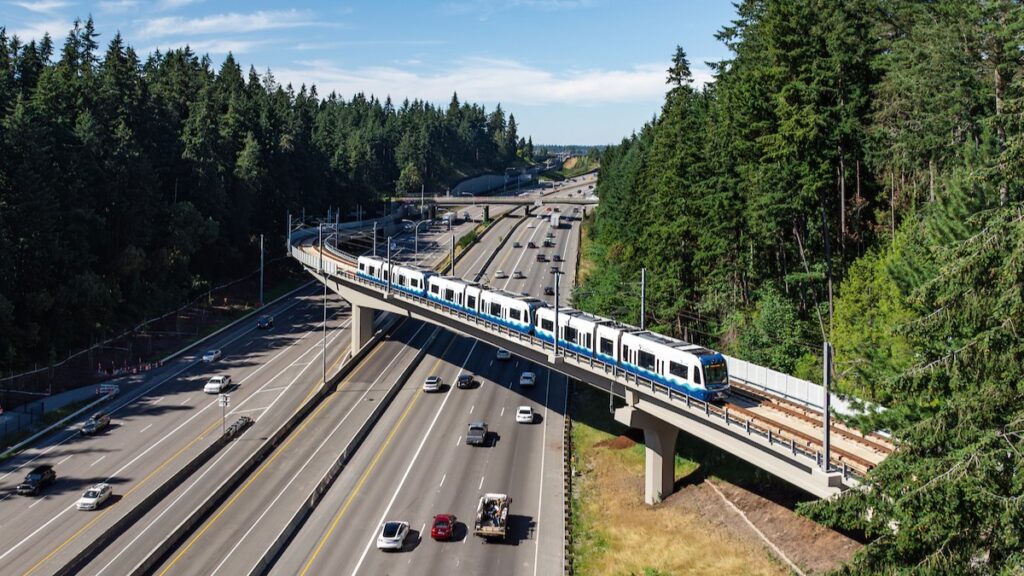
Photo credit: Sound Transit
In 2016, voters in King, Snohomish, and Pierce Counties passed Sound Transit 3, a $54 billion expansion of light rail north to Everett, south to Tacoma, east to Issaquah, and connecting to the neighborhoods of Ballard and West Seattle. Transportation Choices Coalition was proud to lead the campaign that passed this ambitious plan at the ballot.
In 2025, Sound Transit revealed a $35 billion affordability gap for Sound Transit 3 projects created by inflation, rising construction costs, higher interest rates, and post-pandemic revenue uncertainty. Sound Transit launched their internal Enterprise Initiative to look for creative ways to cut costs and unlock more revenue. Transportation Choices Coalition launched the Build the Damn Trains coalition to help bring the voices of transit riders and transit advocates to the table.
Throughout 2026, the Sound Transit Board has been working toward finalizing a new System Update Plan that closes the budget gap.
- At the March 2026 Board retreat, staff presented three illustrative approaches that forced difficult trade-offs around system completion, project phasing, rider experience, and financial constraints.
- The May 7 Executive Committee proposal asked the Board to consider and adopt a System Update Plan that included a list of projects that Sound Transit considered fully funded, partially funded, or without adequate funding (and thus deferred until funding is identified).
- Finally, on May 28, the Board adopted the ST3 System Update Plan (including several amendments), that keeps major rail corridors alive, advances some long-promised projects, and leaves many significant questions about funding, timelines, and accountability unresolved.
Why we organized the Build the Damn Trains Coalition
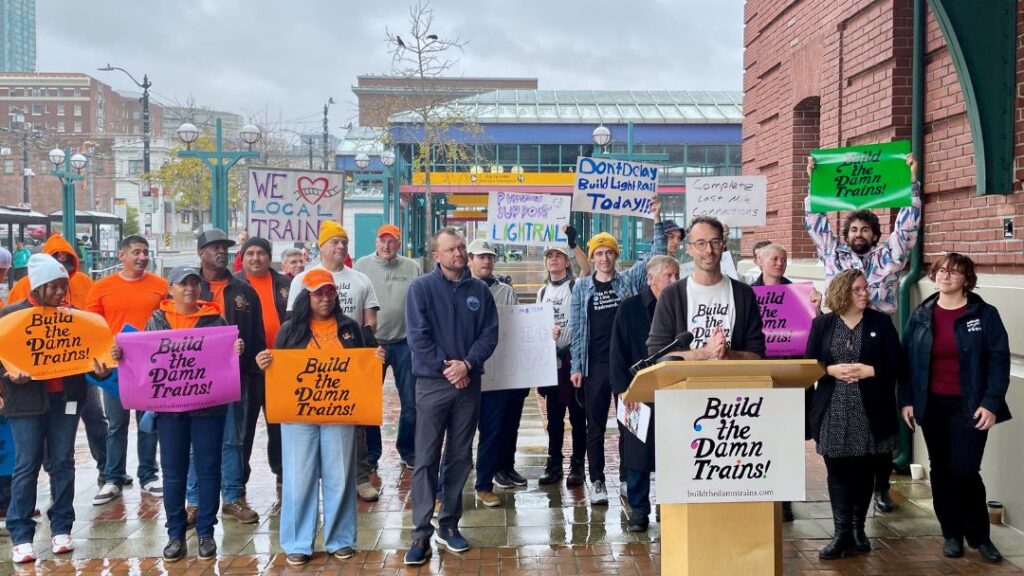
TCC Executive Director Kirk Hovenkotter speaks at the launch event of the Build the Damn Trains Coalition on November 14, 2025.
As the Enterprise Initiative process unfolded and concern grew that parts of the ST3 system could face indefinite delays or cancellation, Transportation Choices Coalition convened the Build the Damn Trains Coalition of transit advocates and riders, housing advocates, labor organizations, environmental groups, and community leaders to create a unified regional voice.
The coalition’s core message was simple: voters approved a regional transit system, and Sound Transit should focus first on finding solutions to deliver that system as a whole. That means using every available tool, such as permitting reform, efficient project delivery and debt solutions, to reduce costs, secure new revenue, keep projects moving, and preserve the voter-approved vision before cutting or pausing indefinitely.
To make that message heard, the coalition took action on multiple fronts. We sent two letters to the Sound Transit Board laying out our priorities, organized two press conferences and rallies, collected over 900 signatures on a petition to the Board, and showed up to testify at board meetings.
In addition to coalition organizing, TCC and our partners Move Redmond, Snotrac, and Tacoma on the Go held a series of Transit Town Halls in each Sound Transit subarea: Pierce, Snohomish, South King County, Seattle, and the Eastside. These events were an opportunity for the public to hear directly from Sound Transit Staff and Board members about the future of ST3 projects. Hundreds of people turned out at each of the events to show their support for getting light rail built. We heard from attendees that they want Sound Transit to protect regional connectivity, avoid canceling light rail projects, secure new funding, and explain the agency’s financial challenges in plain language. These messages were also reflected in Sound Transit’s own engagement process for the Enterprise Initiative.
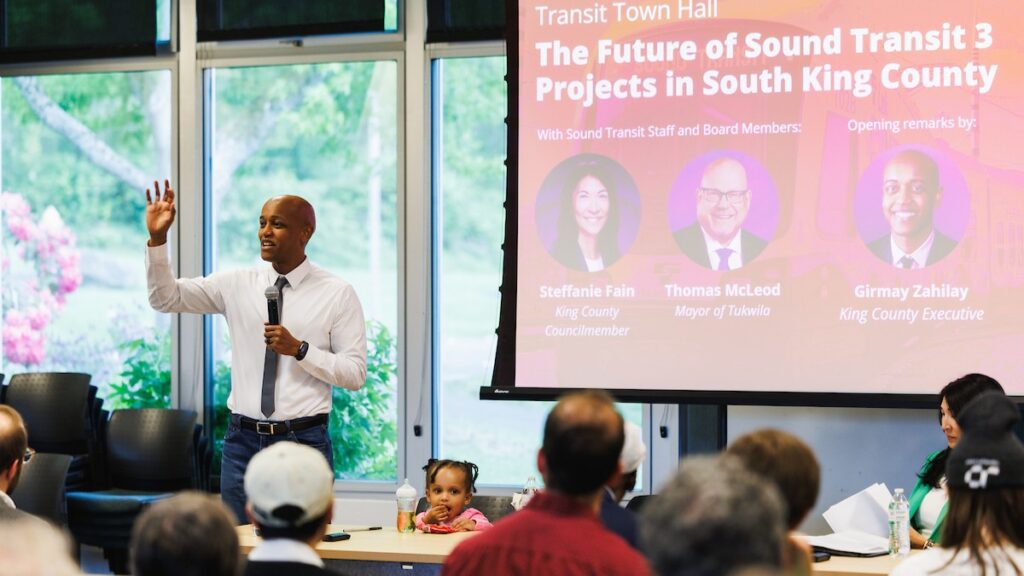
King County Executive Girmay Zahilay speaks at TCC’s Transit Town Hall in South King County on May 13, 2026. Photo credit: Sound Transit.
The Big Picture: No Major Line Is Cancelled
Overall, the plan relies on major cost savings, schedule and financing assumptions, and project deferrals and identifies $11-13B in capital savings but still faces an $9-11B gap for currently unaffordable investments. It assumes $6-8B in savings/additional capacity from other Enterprise workstreams and future efficiencies.
The plan the Board approved is not the full ST3 delivery plan riders deserve, but it moved significantly toward our coalition’s goals compared to the early Enterprise Initiative scenarios. One of the coalition’s clearest priorities was keeping projects in design rather than letting them get cut entirely. Every light rail line continues moving in some form, which matters because it refines cost estimates, preserves institutional knowledge, positions projects for future funding opportunities, and avoids expensive restart costs. It also keeps the region’s design, engineering, construction, and labor workforce engaged. Core network completion is prioritized over most parking expansion, future revenue tools remain on the table, and the Board added direction around delivery innovation, permitting reform, financing strategies, value capture, and use of remaining rental car tax authority, adding about $300M in agency financial capacity over the life of the long-range financial plan.
West Seattle Link moves forward as the clearest near-term construction project, though without Avalon Station. Ballard Link continues, with the initial segment funded to Seattle Center, and final design continuing for the full Ballard project (more on that later). The T Line to Tacoma Community College remains in the plan with a 2043 opening target, and South Kirkland-Issaquah remains funded with a projected 2050 opening. Renton Transit Center Parking Garage is also listed as fully funded.
The May 28 amendments improved the adopted package in several important ways. Most significantly, Graham Street Station is now included as a fully funded project with a 2031 delivery target. Thanks to sustained advocacy from our coalition, community groups, riders, and Seattle Board members, Graham Street now has a clearer path from promise to reality. The Board strengthened direction for Boeing Access Road, required a clearer timeline for Ballard, and advanced work on future revenue, delivery innovation, financial governance, and access investments. These changes directly reflect public demand for more transparency, better explanations of project categories, and clearer cost assumptions.
At the same time, the plan does defer some projects until new funding is identified, including some parking, roadway, and Sounder investments. If additional funding from other parties becomes available, the Board may allocate agency resources to help advance those projects. Learn about details of all the projects in the updated ST3 Plan here.
The adopted plan also performs better than the March Enterprise Initiative scenarios on several key metrics. Staff estimates roughly 600,000 daily rail boardings under the updated plan, representing about 92% of the ST3 baseline, along with stronger access to jobs and population centers and better outcomes for zero-vehicle households.
Where the Board Action Falls Short
While the Board adopted path is a progress, it is not the finish line. The Ballard Link remains active in design, but the segments beyond Seattle Center still lack funded construction. In a welcome move, the May 28 amendments added a near-term accountability step for the Ballard link asking Sound Transit to provide date estimation by August 1, 2026. That is a useful transparency measure, but it does not yet solve the larger funding question for Ballard beyond the initial funded segment.
The plan includes value capture and public-private partnership analysis but lacks a concrete transit-oriented development or public land use strategy. The coalition continues to urge more determined use of public land to reduce costs, generate long-term value, and support ridership. Similarly, while the plan emphasizes design advancement and cost savings, it does not clearly require standardized or simplified station design approaches that could significantly reduce project costs, which our coalition strongly advocated for.
The adopted amendments point in the right direction by requiring more work on permitting reform, right-of-way partnerships, delivery models, technology, and financing innovation. The next test is whether that work produces measurable savings, faster timelines, and clearer public reporting which our coalition has firmly asked for.
Equity and Access: A Major Win, But Unfinished Work
Graham Street is a major equity and access win. At the same time, Boeing Access Road remains unresolved. This equity-focused infill station has also been championed by communities for more than three decades, but it remains active in design without funded construction. The May 28 amendments added new planning direction for the in-fill station which is a progress, but not the same as a construction commitment. The plan also added first-and last-mile access options for north Tukwila.
Other investments, like some of Sounder South Access Improvements, still lack clear construction pathways. However, the May 28 action also established a Regional Parking Fund to support cost-effective and innovative investments in station access and parking to incentivize public-private and public-public partnerships, shared parking arrangements, and other creative approaches to improve transit access. That fund is a useful tool, especially where parking projects were deferred, but it does not replace the need for strong bike, pedestrian, bus, and first- and last-mile access investments. Our coalition maintains these access must be prioritized over structured parking, as these improvements serve more riders and better support those without cars.
These steps move the conversation forward, but they also raise broader questions about how the agency prioritizes equity-focused projects during periods of financial constraint. Long-promised stations cannot remain in perpetual limbo and it weakens public trust in the agency.
Funding and Financial Strategy Still Need Clarity
The proposal identifies remaining rental car tax authority as one near-term funding tool alongside grants, value capture, longer bonds, and future local, state, and federal funding. But phasing and unfunded construction are already built into the plan before those tools are secured.
Sound Transit will pursue federal and state funding, legislative tools to increase debt and bonding capacity, and collaborate with local partners to improve permitting and construction timelines. The adopted amendments also direct Sound Transit to develop future revenue options by Q3 2027 at the latest, including exploring potential regional or subarea funding packages to close remaining ST3 gaps.
That gives the region a clearer next step to secure the funding and policy tools needed to finish the job. The next phase of our advocacy will focus on this. Our coalition has specifically called for a 2027 and 2028 state legislative strategy that includes extended bonding authority, exploration of a higher debt cap, additional permitting reforms, and new progressive revenue options.
Sound Transit’s financing strategies must respond to what the public said through the Enterprise Initiative engagement. People want Sound Transit to secure new state and federal funding, but they also want transparency in the process, credible cost discipline, and a clearer explanation of how the $34.5B affordability gap for the next 20 years emerged and bridged.
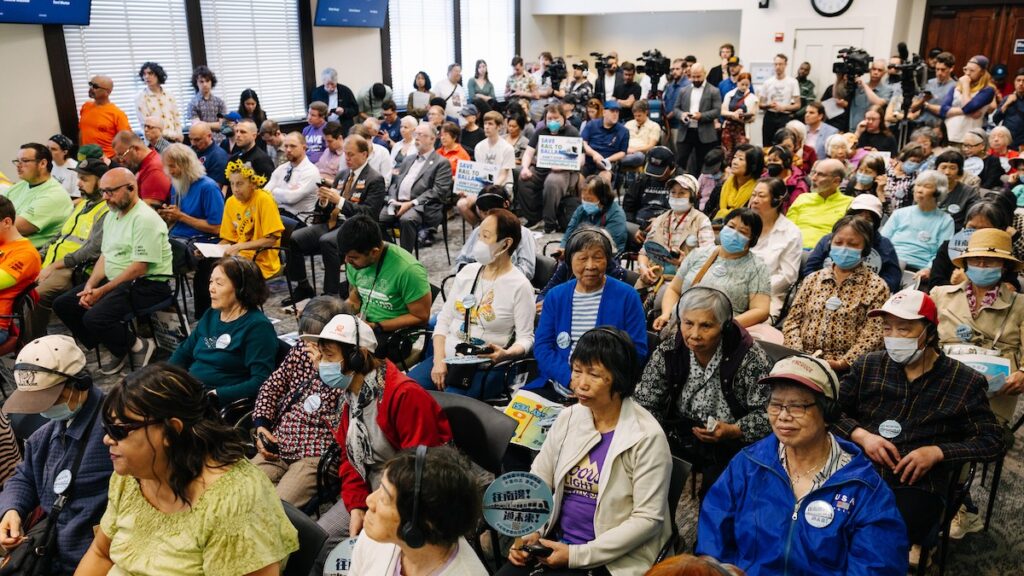
A crowd gathers for the Sound Transit Board vote on an Updated System Plan for Sound Transit 3 on May 28th, 2026. Photo credit: Sound Transit
A New Political Reality for Sound Transit
The Enterprise Initiative process also revealed a changing political landscape inside the Sound Transit Board. West Seattle appears to have strong momentum as the region’s next major construction project. Pierce and Snohomish County leaders strongly defended spine completion. Ballard remains the largest political and network flashpoint. The concerns around subarea equity and regionalized debt-interest cost sharing are also likely to grow. The Graham Street outcome shows the growing influence of sustained public pressure, and Seattle’s role as a right-of-way owner, permitting partner, and potential funding partner. But equity-focused projects still face an uneven path, as Boeing Access Road’s lack of funded construction makes clear.
This makes it clear that progress depends not only on Sound Transit staff, but also on Board members using their authority as local and regional elected officials. Cities, counties, and partner agencies all have a role to play in streamlining permitting, coordinating right-of-way and utility work, resolving interagency issues, reducing unnecessary costs, and keeping projects moving.
What Happens Next
The May 28 vote does not end the conversation around ST3 delivery. In many ways, it begins a new phase. The amendments adopted on May 28 answered some of the previous questions around long-term financing, project delivery timelines, and strengthening work on future revenue, delivery innovation, financial governance, and access investments. Sound Transit must now develop and implement an adaptive program management plan and project delivery framework by the end of 2026, to improve accountability and identify cost savings.
The Build the Damn Trains coalition was created to push for a transit system that is not only preserved on paper, but actually delivered for riders across the region. That means continuing to advocate at Sound Transit, in Olympia, in city halls, and across our communities for the funding, permitting reforms, cost-saving strategies, and accountability needed to build the system voters approved.
For nearly 40 years, the Puget Sound region has built out the country’s fastest growing transit system on its own, without state support. Now the state needs to step up. The Governor and Legislature have a critical role to play in helping this region finish what voters started in 2016.
That work is far from over.