

Division Street in Spokane is typical of a main street highway, with fast-moving lanes and little infrastructure for people outside of cars.
Last year, Washington took an important first step toward confronting its traffic safety crisis. Lawmakers acknowledged that many of our most dangerous roads are the state-owned routes that run straight through our cities and towns, and allocated $100 million to improve safety on them. This year, we continue to have a chance to build on that momentum and strategically fix them.
Everyone knows the main street highway in their community: Highway 2 in Monroe, Pacific Avenue in Tacoma, or Highway 101 in Port Angeles. These roads were built decades ago to move traffic between places. But today, they serve as the main streets of growing cities and towns. Today, homes, small businesses, apartments, schools, and some of the busiest bus routes in the state are along these corridors. That mismatch has made main street highways some of the most dangerous places in Washington.

These roads account for a disproportionate share of fatal and serious injury crashes, especially for people walking, biking, and taking transit. In fact, nearly half of fatal pedestrian crashes in Washington occur on these roads. This is not a coincidence, it’s the result of roads designed for speed being forced to function as streets or places that accommodate activities. You can learn more about what defines a main street highway and why they matter here.
The True Cost of Neglect
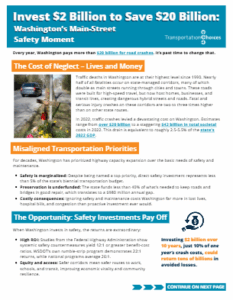
Check out our one-pager on the true costs of the traffic safety crisis.
Traffic violence is often framed as a public safety crisis, but it is also a massive economic one. Each year, Washington pays more than $20 billion in the economic and human costs of crashes, including medical care, emergency response, lost productivity, and long-term disability. Some estimates place the total societal cost as high as $40+ billion annually, equivalent to 2.5-5.5% of the state’s GDP. That’s money leaving families, communities, and the state economy, year after year, because we haven’t fixed the roads we already have.
Despite these staggering losses, our transportation system remains deeply underfunded where it matters most. Safety investments make up only a small share of the overall transportation budget, while preservation needs fall short by billions. For decades, expansion projects have been prioritized first, with safety addressed only if money remains.
The result is very visible: rising fatalities, deteriorating roads, unreliable transit, and main streets that are hostile instead of thriving.
We Know How to Fix These Streets
The good news is that we don’t need new inventions, we already know what works. Rebuilding main street highways with safety and access in mind delivers immediate and lasting benefits. Sidewalks and frequent crossings reduce risky midblock crossings. Narrower lanes and medians slow traffic. Better bus lanes and safer bus stops speed up transit and improve access. Lighting, trees, and safer intersections support local businesses and community life. Washington has already seen success with these approaches on state routes like Aurora Avenue in Shoreline, Alaska Way in Seattle, and 7th Avenue in Seattle.
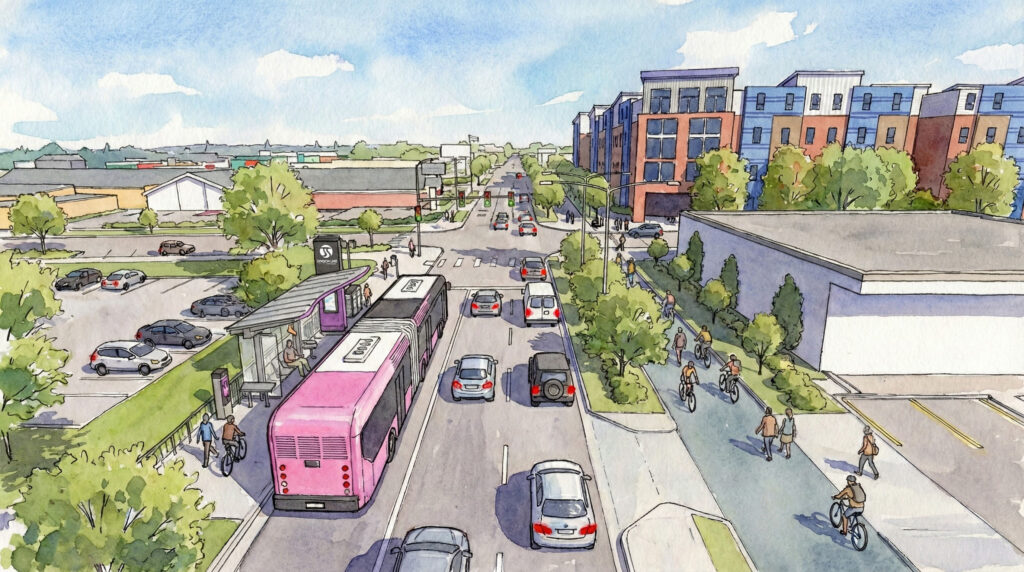
Vision for the future of Division Street in Spokane by Ruby Boone.
Safety investments also deliver exceptional returns. Federal Highway Administration studies show benefit-cost ratios of 12:1 or higher for systemic safety upgrades. WSDOT’s own rumble-strip program delivers returns of about 22:1, and national programs average 26:1. Few public investments save lives and money at the same time.
A Megaproject for Safety
Washington’s Mainstreet highways span roughly 1,100 miles. Transforming them will require focus, funding, and long-term commitment. Washington tackles big transportation challenges through megaprojects. They are long-term, multi-biennium efforts that stay on track despite political or budgetary shifts. We do this for bridges, freight corridors, and transit. It’s time to apply the same approach to safety.
Safety projects on state-owned Mainstreet highways, what we’re calling a Megaproject for Safety, would focus on corridor-scale transformation and deliver visible, lasting change instead of scattering small fixes. It would coordinate safety upgrades with paving, transit investments, and local land-use plans so that these streets support how communities are growing today.
The Opportunity in 2026
Last year, lawmakers took an important first step by approving $100 million starting in 2027 to improve safety on state-owned highways. Now, we need to make sure those dollars deliver real results.
This year, we call on the legislators to keep the momentum going by adopting a budget proviso directing WSDOT to develop a comprehensive Megaproject for Safety plan laying out how current and future funds will be used to prioritize corridors, coordinate investments, and deliver measurable safety outcomes. This planning step doesn’t require new funding yet. But it ensures that when Washington invests, it does so strategically, thinking of a long-term, scalable program focusing on the most dangerous corridors, supporting local economies, and delivering visible improvements people can feel in their daily lives.
Building the Main Streets Washington Deserves
Every year, Washington loses billions of dollars, and far too many lives, to preventable crashes on our streets. A modest, strategic investment can reverse this trend, saving lives while strengthening the backbone of local economies and building thriving communities. It is time to shift from more lanes to safer lanes, and from paying endlessly for crashes to investing in people, places, and opportunity.
Transportation Choices Coalition is prioritizing this work because it delivers for everyone: it puts people to work, speeds up buses, supports small businesses, tackles the hardest safety challenges, and most importantly, saves lives. Learn more about this vision in more detail in our Megaproject for Safety one-pager, which outlines why these corridors matter and how a statewide program can work.
This is our moment to build main streets we can be proud of.