
Last year, we made the case for expanding Washington’s intercity bus network, and the Legislature responded. The program got $5 million in new state funding to make the 2026 World Cup events more accessible. This marks a new chapter for the program as Washington state is taking meaningful steps to strengthen rural connections. This is a big win for riders and communities across the state. But it’s also a reminder: short-term investments aren’t enough to sustain a system that so many Washingtonians rely on.
What the New Funding Makes Possible
The new $5 million investment is already translating into real, on-the-ground improvements:
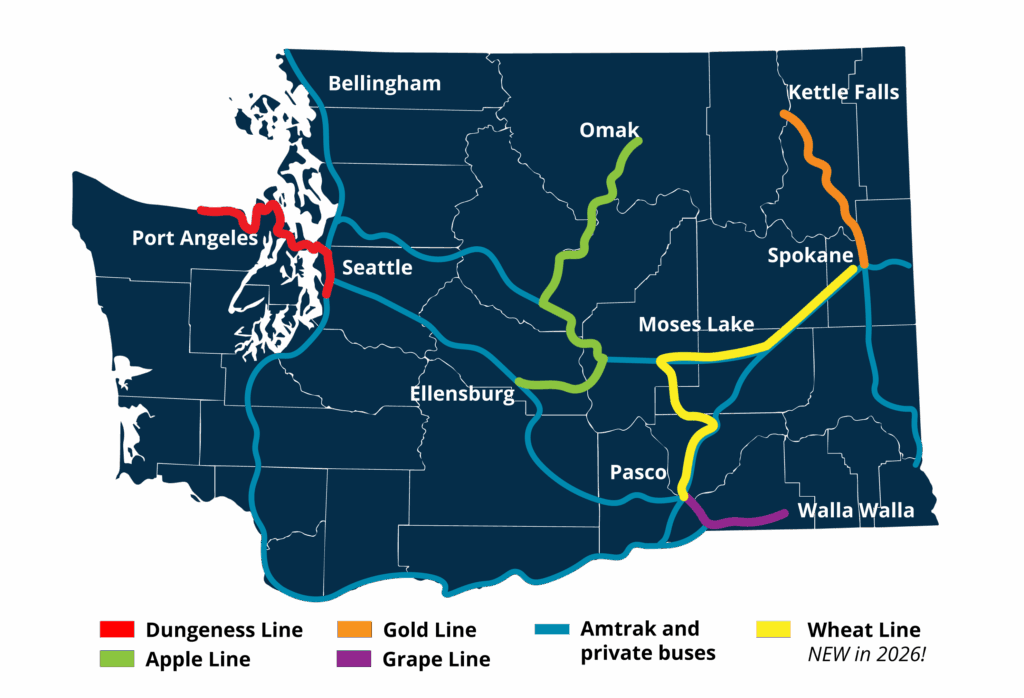
- Increased frequent service on two of the state’s most heavily used routes: the Dungeness Line (Port Angeles to Seattle) and Apple Line (Omak to Ellensburg) each have an additional round-trip per day.
- A new operator for the Dungeness Line to stabilize and strengthen this critical corridor.
- A new route, the Wheat Line, connecting Spokane and Pasco via Moses Lake is expected to launch in April 2026.
In addition to service expansions, WSDOT has launched two pilot routes designed to meet emerging travel needs and test demand, supported by a mix of remaining COVID relief funds and the new $5 million allocation:
- A Spokane to Seattle route, serving rural communities along the way and improving access to major airports
- A Yakima to Pasco route, with two round-trips planned per day
Together, these changes mean better reliability, more travel options, and stronger connections between rural communities and regional hubs. However, the limitation is that without new, ongoing funding, these services cannot be sustained once the current funds expire.
The Funding Cliff Ahead
The current investments from the state are time-limited and tied to the 2025-27 biennium. At the same time, federal funding for intercity bus programs has remained largely flat for years and is not sufficient to sustain operations. Without stable state funding, Washington risks losing hard-won progress, and potentially seeing routes reduced or eliminated.
The need for sustained support for this program is clear. Public transportation plays a vital role in the lives of Washingtonians: half of our state’s residents rely on public transportation, and a quarter lack driver’s licenses, and yet only about 5% of our state’s transportation budget is spent on public transportation. Sustained investment is essential to ensure Washington’s intercity bus program remains reliable, resilient, and available to the people who depend on it most.
What’s Needed to Keep Washington Connected
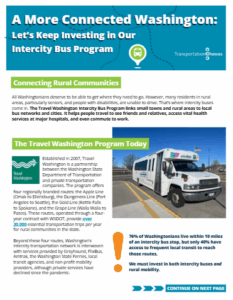
Check out our one-pager!
Intercity bus riders today are more diverse than ever. Along with rural residents, many young people and women rely on these services to get to work, school, healthcare, and family. That means safe, well-lit, and predictable places to board and exit buses matter. As private bus companies across the country scale back or leave the market, the responsibility to keep these connections intact increasingly falls to the public sector. In addition, in many rural communities, intercity buses are the only affordable way to travel long distances and connect to the national transportation network. The upcoming Wheat Line allows riders to connect to Amtrak’s Empire Builder, providing access all the way to Chicago.
To sustain the program at its current level, while meeting administrative needs and supporting dedicated staff positions, WSDOT needs $10 million per biennium in ongoing operating funding. This stability would allow the service to maintain existing routes, manage contracts and data responsibly, and respond to growing demand.
One-time state investments have proven they can unlock service expansions, and establish stronger connections between communities. But without long-term funding, those gains are temporary.
The Time to Act is Now
As our state grows, public transportation must be a key component of our infrastructure. Expanding intercity bus service is critical to provide underserved rural communities access to essential services, jobs, and healthcare.
2025 showed what’s possible when the state invests. Now is the time to sustain that progress.
This year, Transportation Choices Coalition is advocating for a state commitment of $10 million per biennium to keep existing routes running, support safe and reliable service, and provide the stability needed to plan for the future. With private operators leaving the market and federal funding falling short, state leadership is essential.
Washington can protect the gains made in 2025 and ensure the intercity bus program remains a lifeline for communities across the state.
We need your support to move this forward. Sign up for our emails to get updates throughout the 2026 legislative session and help us build a more connected Washington.