Photo courtesy of Sound Transit.
Puget Sound voters have repeatedly said “yes” to building out regional light rail for faster, more reliable transit. However, the region is challenged to do two difficult things at once: finish the voter-approved regional transit expansion (Sound Transit 3) and operate and modernize a rapidly growing system in a construction market where costs have risen sharply, revenues are not keeping pace, and financing has gotten more expensive.
In Fall 2025, the regional transit agency, Sound Transit, estimated that an additional $34.5 billion would be needed to fully fund the Sound Transit 3 program through 2046 across its roughly $150-billion Long Range Plan.
It is in this context that Sound Transit launched the Enterprise Initiative in May 2025, specifically to deliver the maximum benefits of Sound Transit 3 within available financial resources, noting that past affordability fixes leaned heavily on blunt options like delays and scope reductions. Learn more about the Enterprise Initiative here.
Where the State Fits In: Modifying Transit Financing Tools
As Sound Transit works through its Enterprise Initiative, there is a clear role for the state to ensure regional transit agencies have access to practical, flexible financing tools that reflect the long-lived nature of major infrastructure investments. Senate Bill 6148 in the 2026 legislative session is one such tool.
It makes a technical change to the Washington statute and allows regional transit authorities to issue longer-term bonds up to 75 years, while maintaining voter protections and state funding safeguards. Under existing state law, local governments default to a 40-year maximum term for general obligation bonds unless another statute provides otherwise, and many agencies commonly use 25- to 30-year terms in practice. While most U.S. Treasury bonds are issued at shorter maturities (typically 20 to 30 years), federal transportation credit programs such as TIFIA and RRIF can authorize maturities up to 75 years for qualifying infrastructure projects, with actual loan terms structured based on the usefulness of the asset. Therefore, the 75-year authority under this bill follows a recognized special purpose practice and provides additional flexibility in structuring financing for very long-lived infrastructure.
The provisions of SB 6148 are applicable for both General obligation bonds (tax-backed bonds that require voter approval) and Revenue bonds issued by these agencies. The bill includes an important caveat to balance the flexibility: If a transit authority issues any bonds with terms longer than 40 years, it becomes ineligible for funding from the state’s Regional Mobility Grant Program.
Sen. Marko Liias, the sponsor of the bill, explains that the idea is to give regional partners “as many tools as possible” to minimize construction delays, navigate market uncertainty, and deliver promised projects quickly and at the lowest possible cost.
Extending the term can lower annual payments and help lower near-term costs. This empowers agencies to deliver projects in a reasonable timeframe. However, it may increase the total interest paid over time.
The implications: What Senate Bill 6148 could unlock for the region
- SB 6148 does not force Sound Transit to issue 75-year bonds. It simply adds the option in its financial toolkit for long-lived infrastructure assets while maintaining voter accountability for tax-backed debt.
- Helps deliver voter-approved projects by giving the agency a more flexible financing tool that matches the life of some of the transformative assets it is building.
- Reduces the cost of delay by smoothing annual debt service and improving cash-flow flexibility, potentially helping avoid the most harmful outcome: delays that increase costs and erode public trust.
- Supports a vibrant and more reliable multimodal network in the region that prioritizes safety, climate resilience, affordability, and equitable access.
What it does not do
It does not create new taxes, does not reduce voter control over debt authorization, and does not pull away essential funding from other state priorities. The Senate Democrats emphasize that Sound Transit would still need 60% voter approval for new debt that exceeds the statutory 1.5% limit of the total assessed value of taxable property within the Sound Transit district.
This bill does not entirely solve the affordability crisis, but it is one of the risk-reducing tools that gives regional transit agencies a practical approach to help keep the promise of expanded, equitable, and sustainable voter-approved transit for Puget Sound.
Previous Attempts and How this Debate Has Evolved
The concept of 75-year bonding for Sound Transit is not new in Olympia. In April 2025, there was a similar legislative proposal (SB 5801) to allow 75-year bonds as a response to Sound Transit’s looming cash-flow crunch. That bill passed the Senate but did not advance in the House amid broader budget negotiations and concerns about long-term debt. This year’s Senate bill should be seen as a refinement and continuation of that conversation.
This year’s effort is a bipartisan response to the same underlying challenge, with lawmakers from both parties acknowledging the need for pragmatic tools to address rising construction costs and delivery risk for voter-approved projects while preserving flexibility for agencies and guardrails for debt authorization.
The Regional Mobility Grants Question
One of the key questions raised about SB 6148 is whether becoming ineligible for Regional Mobility Grant would meaningfully harm Sound Transit’s ability to fund projects. To understand why this is not a major constraint for Sound Transit’s capital projects delivery, we need to look at scale and funding structure. WSDOT’s Regional Mobility Grants is a statewide, competitive program in the range of tens-of-millions per biennium.
In the 2025-27 biennium, the awards to transit agencies was budgeted about $77.6 million. This includes funds programmed to continuing projects from the 2023-25 biennium and funding available for new awards, and identifies contingency projects if budget allows.
For Sound Transit, Regional Mobility Grants contribute modestly to specific project elements or complementary investments, but they are not central to its capital delivery financing. In the 2025-27 biennium, Sound Transit received about $12 million from the state for their projects, often for supportive elements like station access, fleet/equipment, or corridor improvements. While it is meaningful, the grant funds from the state support a very small part of the projects compared with the multi-billion-dollar scale of Sound Transit 3 capital projects and the broader affordability challenge that Sound Transit faces.
Sound Transit’s primary funding sources are a combination of local taxes, federal grants and loans, and borrowing, plus fares and other revenues.
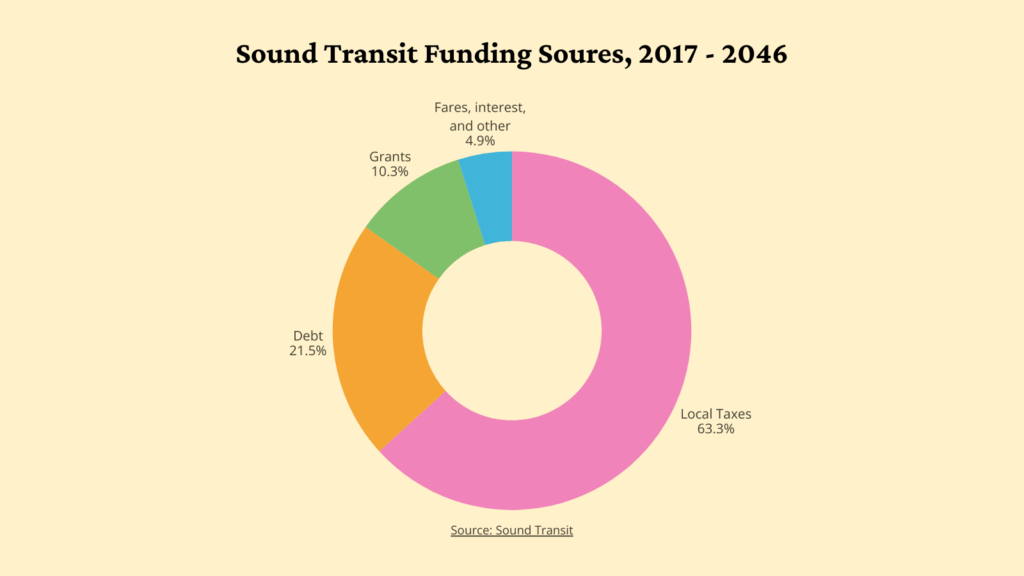
Source: Sound Transit Funding Summary
A Responsible Tool, Not a Bailout
In conclusion, SB 6148 is not a silver bullet, and it is not a substitute for the broader decisions Sound Transit and the region must make through the Enterprise Initiative and long-range planning process, nor will it rewrite Sound Transit’s Financial Plan. It is a thoughtful, practical, bipartisan response to a clear fiscal challenge confronting regional transit delivery, while keeping key safeguards in place.
Transportation Choices Coalition supports SB 6148 because it helps Build The Damn Trains, while strengthening the region’s financial toolkit, respecting voter authority, and helping ensure that our region benefits from investments in safer, cleaner, more accessible transportation. It keeps these projects moving, protects riders and communities from endless delays, and builds a safe, sustainable, equitable transportation system the region has repeatedly demanded.
You can send a comment letting legislators know you support SB 6148 here. We need to show that this bill matters to people all across the Puget Sound region.