Each year, Transportation Choices Coalition honors individuals and organizations making a difference in transportation across Washington. Our 2025 inductees into the Transportation Choices Hall of Fame are improving how people move through their communities by advocating for safe, reliable, and inclusive transportation options.
This year, we’re excited to recognize Fix the L8 and Move Redmond for their outstanding leadership and dedication to better transit for everyone.
We asked our inductees to share more about their work in their own words. Read on to hear more from our inductees.
Fix the L8
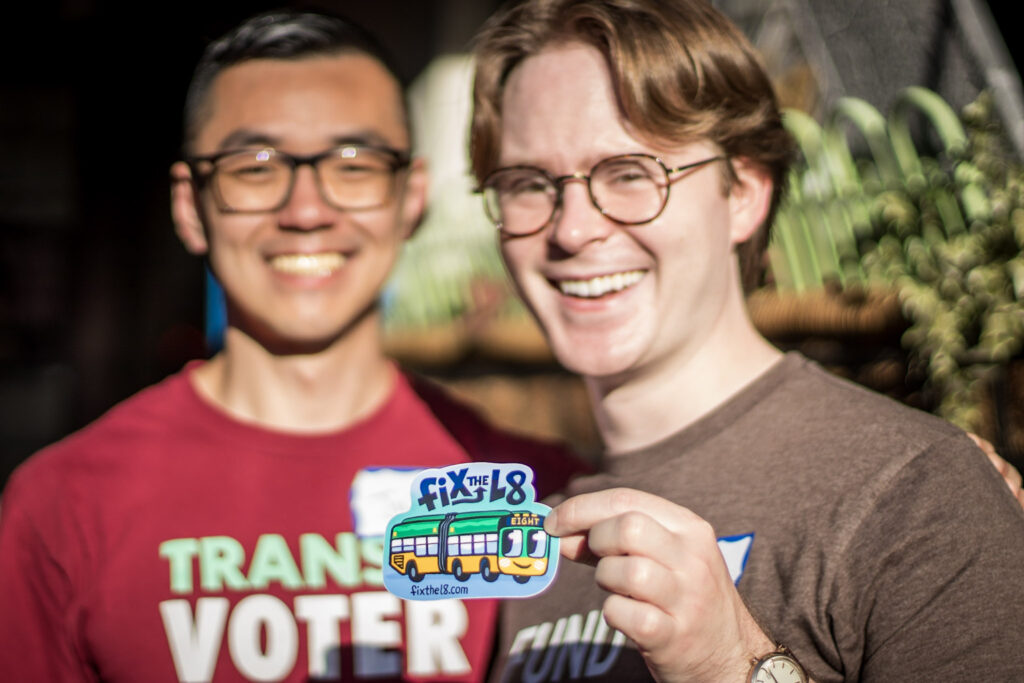
Campaign leaders Jason Li and Nick Sattele with a Fix the L8 sticker.
Can you explain what Fix the L8 does, and why this work and the Race the L8 event was important to you and your community?
Fix the L8 is a grassroots advocacy campaign focused on improving speed and reliability for King County Metro’s Route 8 bus. Route 8 is the slowest and least reliable bus in the entire network. It is often stuck in traffic that turns Denny Way into a glorified parking lot. The route has been infamous around the city for decades. The Stranger named it “Seattle’s Crappiest Bus Route” in 2009. A local band Tacocat released a song called “F. U. #8” in 2014. The Seattle Times Editorial Board described it as “legendary” earlier this year.
As the only east-west transit connection between downtown Seattle and the ship canal, Route 8 is a key component of the transit network. As a testament to this, 7,000 people ride it every day and it is still one of the top-ten most popular bus routes in the entire city despite being literally slower than walking. Unfortunately, the city has failed to take meaningful action and has allowed Route 8 reliability to remain as low as 30% on-time during the evening rush hour.
We demonstrated issues with the 8 earlier this summer by outwalking and outdancing the bus during our Race the L8 event. Over 200 participants showed up and beat the bus doing some of the slowest things they could.
Our campaign is hoping to fix the 8 by pushing for full-length two-way bus lanes on Denny Way from Queen Anne Avenue to Stewart Street. This would finally give transit riders a fast and reliable transportation option while making significant strides to meet Seattle’s transportation, climate, and equity goals.
What Fix the L8 achievements are you most proud of?
We were blown away by the support and publicity our Race the L8 event received. The race not only proved that the bus is significantly slower than walking, but it also finally gave a voice to the thousands of transit riders frustrated with the route. Impacts of transit projects on drivers have dominated news cycles for far too long. We are proud to play a part in finally giving transit riders a way to voice their frustrations to the city and show how important the route is to them.
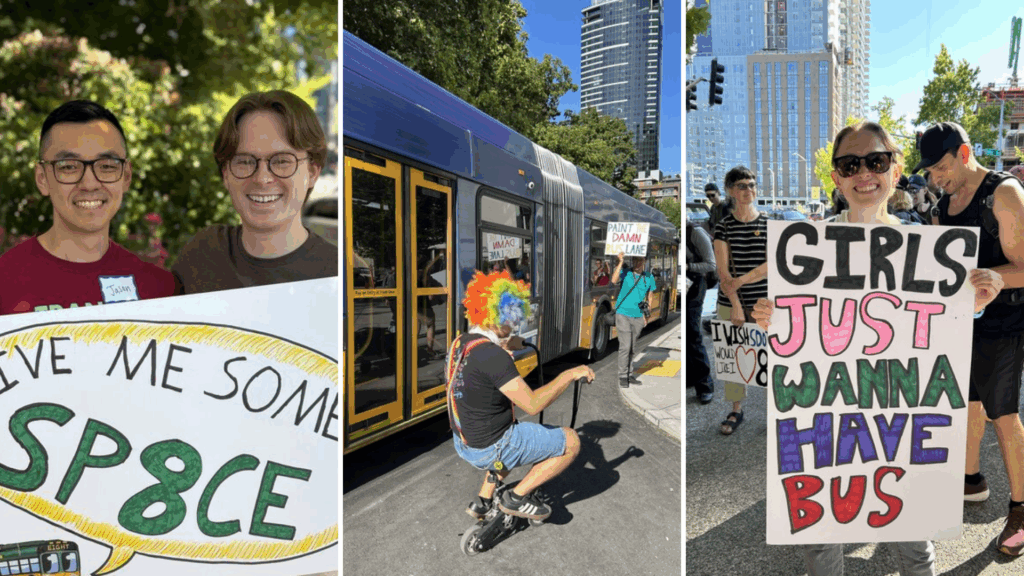
TCC photos from the Race the L8 event.
This October, we were also proud to stand and speak alongside Councilmember Alexis Mercedes Rinck to announce her Better Bus Lanes campaign, which hopes to bring the bus lanes our campaign has been demanding for years and now has majority support in City Council. We are also excited to have the support of County Councilmember Teresa Mosqueda and State Representative Julia Reed. We are seeing widespread support from all levels of local government and hope they can come to fruition in the near future.
What is your hope for the future of transit and transportation in Washington?
Having fast, frequent, and reliable public transit to give everyone the freedom of mobility. Owning and driving a car is now more expensive than ever, a third of Washingtonians don’t drive, and the most dangerous thing a child will do is interact with a car. Living in a society predicated on driving isolates and constrains everyone, forcing us to spend time stuck in traffic and searching for parking while pushing us farther away from our neighbors and friends. Personal vehicles are also the largest source of greenhouse gas emissions in the state. We know people hate driving but they choose it because transit is not a viable alternative. We need to be doing as much as we can to invest in transit, cycling, and walking and break free from the constraints and status quo of driving.
At TCC we know working together we go farther. Who have been your greatest allies, partners or influences in your transit work?
Our biggest learning in the campaign is that you can’t do any of this alone. As a joint campaign between Central Seattle Greenways and the Seattle Transit Riders Union, this wouldn’t have started without the advocacy infrastructure laid by them. The reporting and institutional knowledge held by The Urbanist also elevated awareness of the campaign.
As the campaign evolved, TCC itself has been an incredibly valuable ally. Their deep understanding of transit politics has been instrumental in building invaluable connections with institutional stakeholders to garner support for our campaign. We have also had support from countless other organizations like Seattle Neighborhood Greenways, Seattle Subway, Disability Rights Washington, and even House our Neighbors and Tech 4 Housing.
But the biggest ally has been the public. After we sounded the alarm about Route 8’s issues, the outpouring of support and volunteers gave us enough bandwidth to pull off the Race the L8 event. And the hundreds of people that showed up for Race the L8 proved to the city that transit is popular and Seattleites will fight for it.
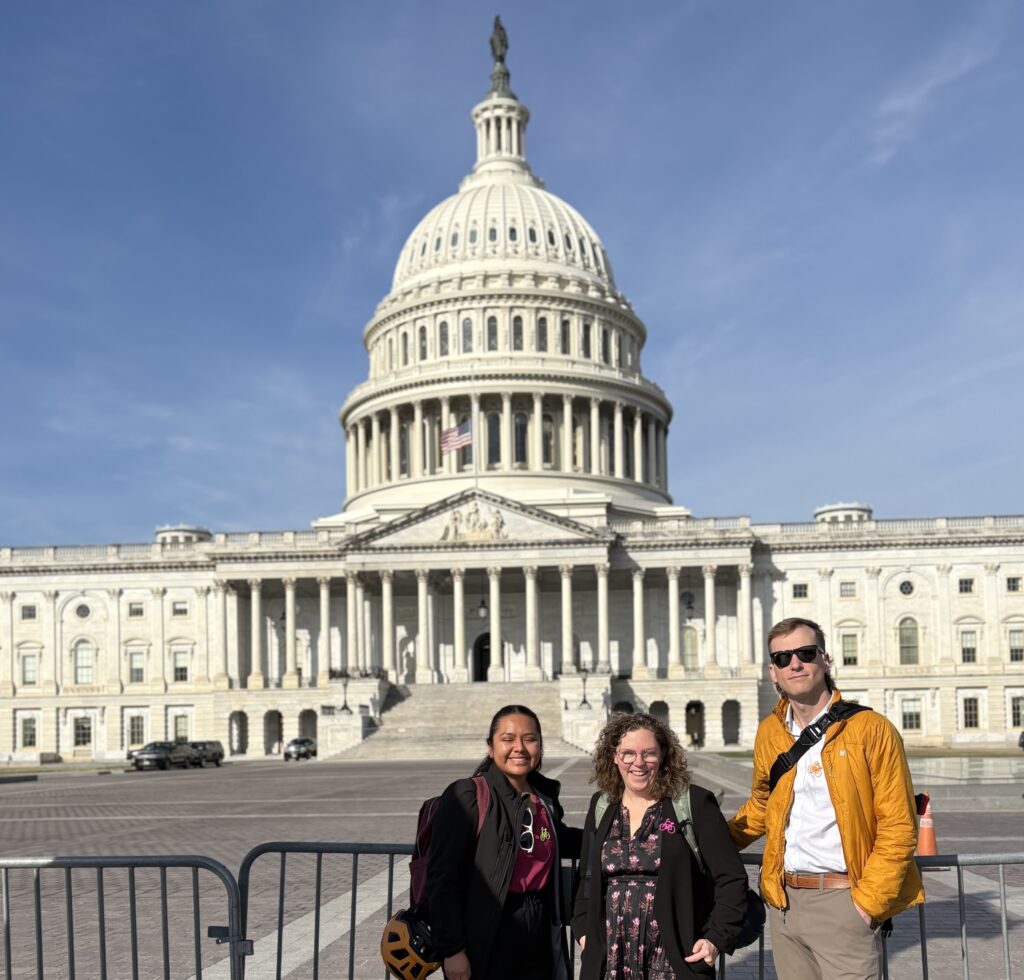
Move Redmond’s Maritza Lauriano Ortega, Kelli Refer, and Michael Leach, in front of the capitol building in Washington, D.C.
Move Redmond and the Trails 2 Transit Celebration
Please explain in your own words what Move Redmond does, and why this work and the Trails 2 Transit event was important to you and your community.
Move Redmond advocates for better streets, trails and transit. The heart of our organization is helping people get around Redmond and the Eastside without driving alone.
Earlier this year, we marked a momentous transit achievement for Redmond with the opening of Sound Transit’s 2 Line extension to downtown Redmond. For the opening, Move Redmond hosted the Trails 2 Transit event – a celebration of the nexus between trails and transit around Downtown Redmond station. This event activated a half mile of the Redmond Central Connector Trail and the light rail station with over 67 local businesses and community partners. We worked in collaboration with Eastrail Partners, who organized five bike rides from around the region to the event, and Africans on the Eastside to curate an electrifying main stage with dancing, drumming and a fashion show. It primed the community to use and enjoy the 2 line extension. Now, Downtown Redmond has the highest ridership of any station on the 2 line.
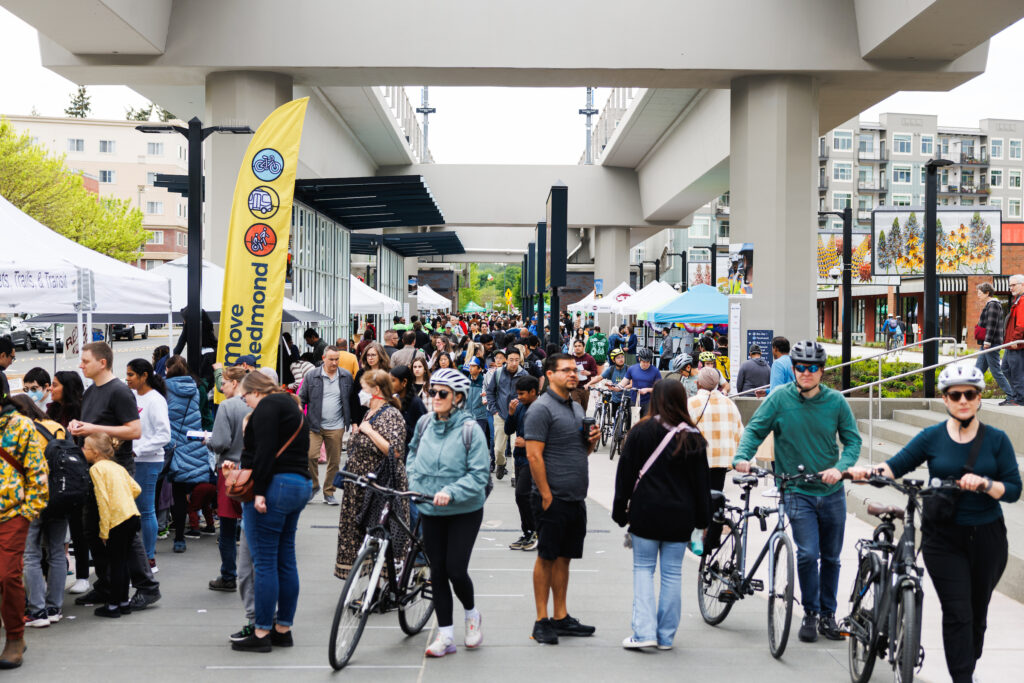
The opening of the Downtown Redmond Link Extension. Photo courtesy of Sound Transit.
What Move Redmond achievements are you most proud of?
Our Station Access Maps are an incredible community resource highlighting transit connections, bike routes and walking routes to help people access the 2 line and navigate the Eastside. We’ve updated the maps as the system expands and have distributed over 13,000 printed maps in the region. Our Station Access Map is available digitally in five languages on our website.
We’re also proud to organize two upcoming events celebrating transit in Redmond. Our annual Walk, Roll, Raise fundraiser is coming up on December 4. And, Move Redmond’s Open Streets Festival, which celebrates what happens when we make streets places where people can connect and thrive, will be on Saturday, August 15th, 2026!
What is your hope for the future of transit and transportation in Washington?
The highest priority is ensuring that people all across Washington State have frequent and reliable transit with stable transportation funding.
We also need to modernize commute trip reduction. As a Transportation Management Association, Move Redmond has supported employers in compliance with Washington State’s Commute Trip Reduction (CTR) law. We’ve seen this policy succeed in reducing vehicle miles travelled. But, the current policy has some limitations. For example, shift workers, overnight shifts, and part-time or limited-term employees do not qualify for the program. Our goal is to expand the program to be more inclusive of businesses with these types of employees. We aim to do this by removing the “6:00 a.m. to 9:00 a.m.” and “year-round” employment requirements from the CTR law’s definition of “affected employee”. Revising the Commute Trip Reduction Law would make the program more equitable by reaching employees who are often paid less, and are more reliant on transportation options like walking, biking, and transit to get to work.
At TCC we know working together we go farther. Who have been your greatest allies, partners or influences in your transit work?
Move Redmond loves to collaborate with so many wonderful organizations. It has been wonderful this year working with Redmond Library, Eastrail Partners, Eastside for All, Africans on the Eastside, and our fellow TMA’s Commute Seattle, Tacoma on the Go, and Connect Bellevue! We also want to give a huge shout out to local journalists Ryan Packer at The Urbanist and Tom Fucoloro of the Seattle Bike Blog!