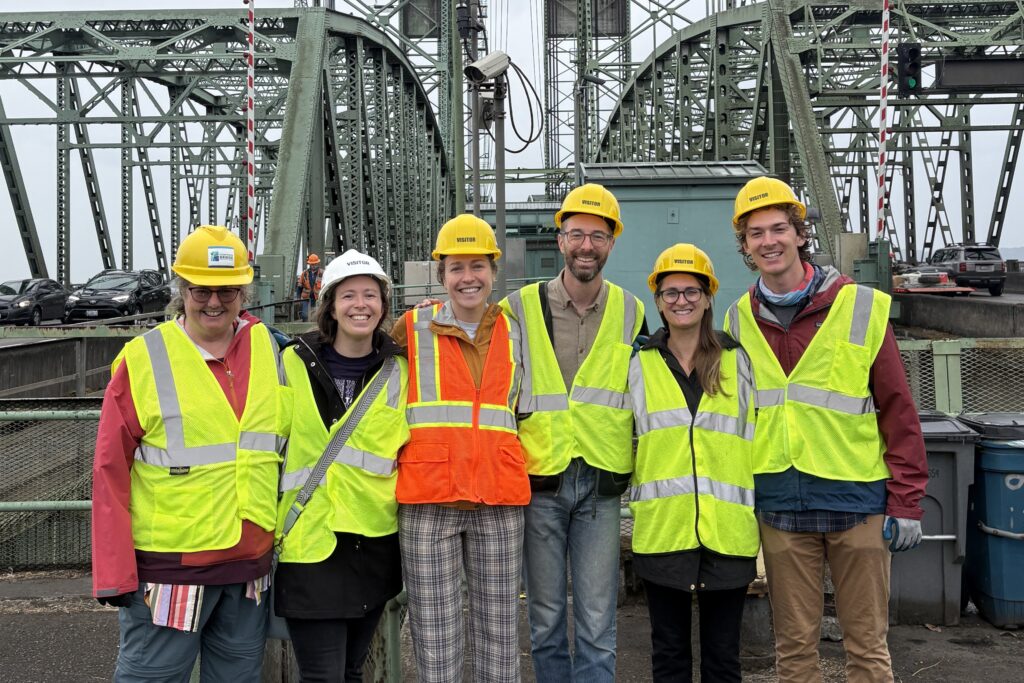
The TCC team tours the current Interstate Bridge between Washington and Oregon.
At Transportation Choices Coalition, a lot of our work involves partnering with Washington communities to build the transit future they want to see. In just the last year, we’ve worked to defend and expand transit funding in Spokane, Seattle, Pierce County, Ellensburg, and Island County. This year, we’ve also begun building relationships in Southwest Washington.
Home to the City of Vancouver, Washington, this region is forecasted to see substantial population growth in the coming years. It’s also in a crucial era for transportation investment, with major decisions ahead on interstate light rail, Bus Rapid Transit construction, and an ambitious 20-year regional transit expansion plan. As Washington’s statewide transit advocacy organization, we want to be of service and support transit investments where they’re needed.
To learn more and strengthen our relationships, the TCC team took a study trip (by train, of course!) to Southwest Washington. Over a couple of intensive days, we met with Vancouver city leadership, advocates from Portland and Vancouver, engineering and design consultants, and transit agencies. Thank you to the Cowlitz Tribal Foundation and STV for their generous support for this trip. Here are a few things we learned that we’ll carry forward into our work.
The Interstate Bridge Replacement Needs Light Rail. But Can We Fund It?
The future of light rail on the Interstate Bridge Replacement is one of the most consequential transportation decisions facing Southwest Washington. The Interstate Bridge Replacement is a project to replace a century-old bridge carrying Interstate 5 over the Columbia River between Portland and Vancouver. This seismically vulnerable structure is in desperate need of replacement, which we can attest to after touring the bridge’s VERY old and shaky operator room. But if you’ve paid attention over the past two decades, you’ll know this megaproject has been politically and economically fraught. Momentum toward a bridge replacement already failed once in the mid-2010s.
The current project design includes dedicated facilities for light rail, bikes, and pedestrians alongside motor vehicles. It reached a major milestone in July 2026 when federal agencies approved a 1.9-mile extension of Portland’s MAX Yellow Line into Vancouver with stations at Hayden Island, Vancouver Waterfront, and Evergreen Boulevard/Library Square. Light rail between Portland, Oregon, and Vancouver, Washington, would be a boon for both cities, helping people access jobs, commerce, and other opportunities, and providing an alternative to driving that would curb traffic and reduce climate pollution.
Unfortunately, the project also faces significant funding challenges. The estimated cost for the full five-mile Interstate Bridge Replacement project is $13.5–$15.2 billion, with only $5.69 billion currently committed for the first phase. The project’s current funding only commits to making the bridge “light-rail-ready” and to building to the Vancouver Waterfront station, rather than to Evergreen Boulevard. This means that instead of connecting transit riders to downtown Vancouver and local transit options, the line would end at an elevated station disconnected from the city’s center.
Additionally, the estimated cost for Washington’s share of annual light rail operations and maintenance is $4.12 million, yet no funding source has been identified for that. And with the current federal administration directing transportation funding toward road projects rather than transit expansion, the funding landscape for light rail is increasingly challenging. While many local and state leaders support the light rail extension, sustained advocacy will be critical to close the funding gap and keep the project moving forward.
C-TRAN’s Vine RapidRide Expansion Shows What Local Leadership Can Accomplish
Here’s a bright spot in Southwest Washington’s transit landscape: in recent years, local transit agency C-TRAN has ambitiously expanded its Vine RapidRide system. The system launched with the Green Line in 2017. The Green Line now carries 45 percent more riders than the bus route it replaced, while reducing operating costs by 21 percent. The Red Line opened in October 2023. It drew over 115,000 riders in its first two months alone, a 30 percent increase from its predecessor. Annual ridership across both lines now exceeds 1.8 million trips. C-TRAN has demonstrated how effective quality Bus Rapid Transit can be.
C-Tran is currently building a third line, the Purple Line, along Highway 99. It’s scheduled to open in 2027, and they’ve planned additional Green Line extensions for the same year. The agency has moved these projects forward efficiently through a mixed-funding approach that doesn’t require waiting for massive federal funding packages. This pragmatic, locally-driven strategy offers a model for how transit agencies can deliver major capital projects without getting bogged down in years of permitting and federal environmental review.
Transit Riders Need a Bigger Voice in Southwest Washington
At a happy hour with local advocates, we observed an interesting dynamic in the regional advocacy landscape. Portland and Oregon have well-established communities actively engaged in transit planning and regional coordination, like The Street Trust and Oregon Walks. On the Washington side, an equivalent community voice has not come together yet.
We spoke with local experts, dedicated small-business owners, and disability advocates who have been carrying the water for multimodal needs on the Interstate Bridge project. But we heard repeatedly that there isn’t a strong transit advocacy organization or coalition to speak up for transit riders in Southwest Washington. A stronger local advocacy network in Vancouver and across Clark County would help ensure that Washington transit riders’ perspectives and priorities are more fully reflected in regional transportation planning.
Southwest Washington is a growing region with growing transportation needs. The decisions made in the next few years about light rail, bus rapid transit, and regional connections will have consequences for many decades to come. Our trip reinforced the idea that communities that are intentional about building transit achieve better outcomes. C-TRAN’s Vine demonstrates what’s possible when a transit agency commits to delivering results. The Interstate Bridge project shows both the opportunity and the challenge of thinking big. And the emergent advocacy landscape in Southwest Washington signals an appetite for change.
TCC is committed to being a partner in this work. We’ll continue supporting local leadership, lifting up the voices of transit riders and advocates, and helping make the case for investments that connect communities and strengthen the region.