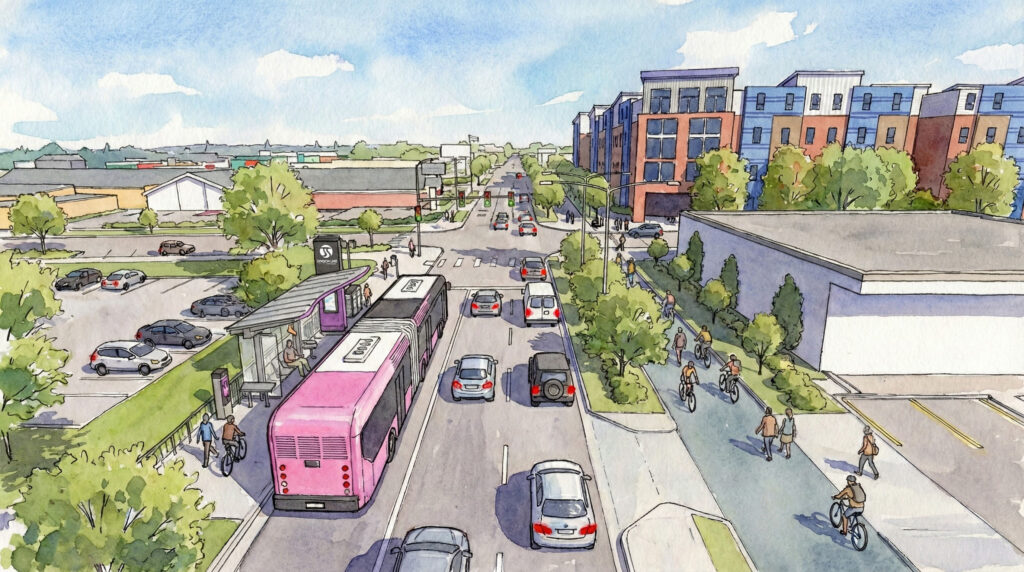
 A vision for the future of Division Street in Spokane. Illustration by Ruby Boone.
As Washington makes historic investments in public transit, we continue to think through an important question: how do we ensure these investments actually deliver abundance to communities, making them healthier, safer, and more equitable?
This question was at the center of a recent collaboration between graduate students in the University of Washington’s MPH Health Policy Development course and Transportation Choices Coalition. The collaboration was built around exploring how transportation policy decisions translate into real, measurable community outcomes.
At the core of this work was a shared recognition that transportation systems shape daily health outcomes through safety, air quality, access to opportunity, and cost burden. Yet these outcomes are not consistently built into or measured in transit and transit-related investments, particularly in policies that advance transit-oriented development across the state.
Why this conversation is happening now
Over the course of the quarter, students worked with TCC to examine transit-oriented development not only as a housing or land use strategy, but as a public health opportunity with traffic safety, equity, and access as central outcomes. At the same time, similar questions are being raised nationally about what it means to invest in transportation and infrastructure in ways that truly expand opportunity.
Nationally, there is growing discussion around what some are calling an abundance approach to infrastructure and housing. In transportation, that conversation is still evolving. Some advocates frame abundance as expanding access to mobility options such as transit, walking, and biking. Others caution that, without clear definitions, abundance could default to expanding highway capacity, which has historically been associated with displacement, safety risks for people outside vehicles, and environmental impacts in many communities.
There is also growing recognition that communities often face scarcity not in highway capacity, but in safe sidewalks, protected bike infrastructure, and reliable transit service. These gaps directly affect safety, access to jobs and healthcare, and overall quality of life. These national conversations helped shape how we approached TOD in Washington, especially the need to understand place-based outcomes.
Narrowing to what matters
The project began with a wide policy lens. Students explored the growing momentum around TOD in Washington, particularly following recent state legislation to increase housing near frequent transit. Early discussions made something clear: TOD policy conversations often happen in silos, with housing, transportation, safety, and health treated as separate goals, and not integrated as they should be.
The project intentionally evolved through collaboration. Through ongoing feedback and discussion, the project scope narrowed to a more focused and practical question. How can TOD policies in Washington be better aligned with public health goals, especially traffic safety, environmental health, and equitable access, in specific places? This shift helped move the work from abstract policy history to outcomes that people experience in their daily lives.
Grounding policy in real corridors
To make the analysis concrete, students focused on two transit corridors, Rainier Avenue South in Seattle and Division Street in Spokane. Both are major transit corridors, both serve historically underserved communities, and both experience high rates of traffic injury.
Looking at these corridors reinforced an important insight. TOD alone does not guarantee safer or healthier outcomes. Without intentional coordination with street design, traffic safety investments, and anti-displacement tools, new development near transit can coexist with dangerous streets and rising cost pressures.
Using a corridor lens also helped students understand data limitations and opportunities. It clarified what can be measured today, what cannot, and what kinds of data would be needed to better connect transportation investment to public health outcomes.
Integrating data and policy analysis
Within the constraints of a ten week academic timeline, the goal was not to build a comprehensive statewide analysis. Instead, students developed a two part framework.
The first part was a simple quantitative dashboard to compare corridors on indicators such as traffic safety, access to transit, air quality exposure, and housing affordability. The second part was a qualitative policy evaluation matrix to assess how different policy approaches could improve those outcomes.
Together, these tools demonstrated how health, safety, housing, and transportation considerations can be integrated, even when data is imperfect. This mirrors real world policy and advocacy conditions, where decisions are often made with partial or incomplete information.
Learning from practitioners
The project was strengthened by interviews with transportation, public health, and community practitioners across the state. These conversations highlighted several recurring themes:
- Safety and health goals are widely shared but not always fully resourced.
- Responsibilities are spread across agencies, making coordination difficult.
- Data on health and safety outcomes near transit is improving, but still lags behind housing and ridership metrics.
Arriving at a shared conclusion
 By the end of the project, a clear conclusion emerged: If Washington wants transit-oriented development to deliver on its full promise, health and safety outcomes need to be intentionally built into policy, funding, and implementation, and not assumed.
The final report and policy brief emphasize that traffic safety is a public health issue and be central to TOD implementation. They highlight the need to address equity and displacement alongside new development. They also call for measuring success not just by housing units or transit use, but by safer streets, cleaner air, and access to opportunity in transit served communities. This project adds a place-based perspective on how those outcomes can be realized on the ground.
We are beginning to see traction around these ideas in regional planning conversations. The Puget Sound Regional Council’s recent draft Regional Transportation Plan, identifies health, safety, and equity as important outcomes of transportation planning.
Why this collaboration matters
For the students, the project offered an opportunity to apply policy analysis skills in a real world context, working within constraints, balancing research, data limitations, stakeholder input, and implementation realities, while responding to feedback, and translating research into actionable insights.
For TCC, the work helps strengthen our advocacy for safe, sustainable, and equitable transportation. It supports a vision of transit-oriented development that resonates with public health, safety, and equity priorities, and serves as a reminder that how we build around transit matters as much as how much we build.
As Washington continues to invest in transit and shape communities around new stations, these lessons are directly relevant to how future investments are planned and implemented and that lead to healthier and safer outcomes for everyone.