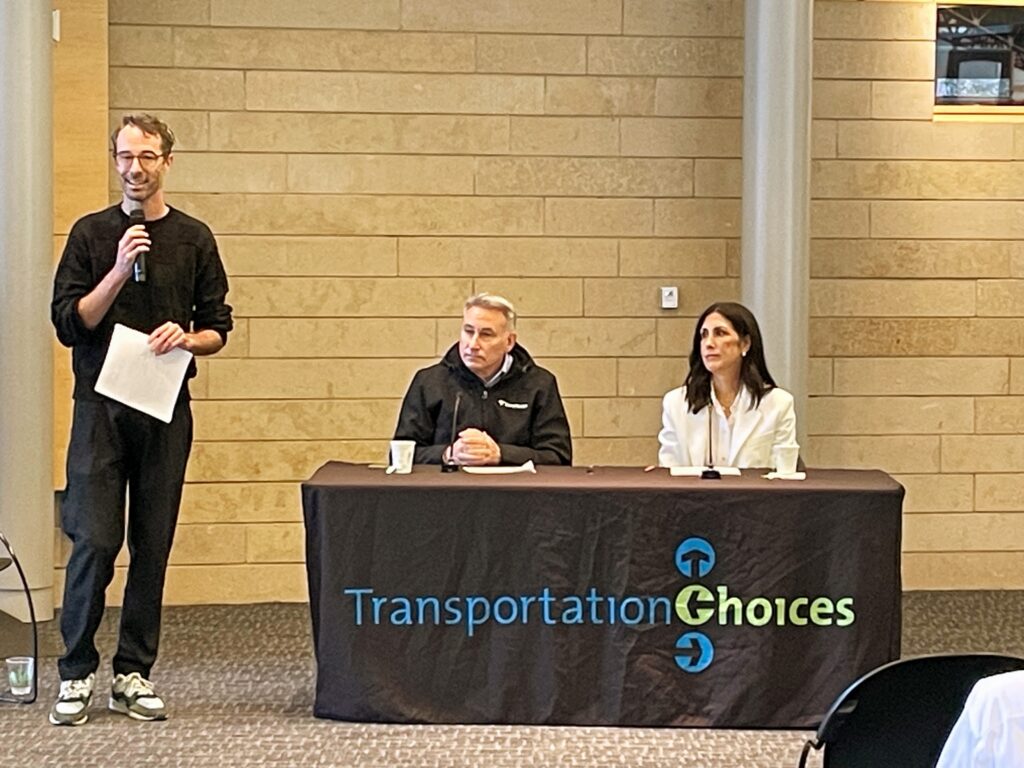
At Transportation Choices Coalition’s first in-person Transit Talk in more than three years, Sound Transit CEO Dow Constantine and Deputy CEO Terri Mestas shared how the agency is tackling the challenges of building out the region’s light rail network and delivering the voter-approved Sound Transit 3 projects.
Here are five key takeaways from their conversation.
1. The Enterprise Initiative is Sound Transit’s roadmap for financial and operational discipline
In a presentation to the board in August, Sound Transit reported a $30–40 billion affordability gap in its long-term financial plan as a result of inflation related to capital costs, a revenue shortfall, and increasing costs to operate and maintain light rail. Constantine noted that without change, the agency would face serious financial pressure, stating that “by the early 2040s we would not be able to both operate and finish building out our system.”
In anticipation of these cost increases, Sound Transit has launched the Enterprise Initiative, a strategic effort to keep the agency’s long-range financial plan in balance while delivering the expansion of the rail system. The initiative is structured around four key areas: capital delivery, operations and service, finance, and policy. Mestas described how this “four-legged stool” allows the board and staff to adjust multiple levers rather than relying solely on scope or schedule reductions.
Unlike past moments when Sound Transit faced financial challenges, the agency is not simply cutting projects back. The Enterprise Initiative is about rethinking how the entire agency aligns its planning, delivery, operations, and finances—and giving the board more meaningful decision tools.
2. Cost pressures are real, but creative thinking—not simply austerity—is the response
Mestas and Constantine were candid that material and labor costs, real estate constraints, and global supply chain disruptions are eating into project budgets. Mestas noted that material costs remain elevated post-COVID, labor rates continue to climb, and site and geotechnical uncertainties add risk.
Rather than defaulting to project cuts, Mestas highlighted the agency’s use of opportunity registers—currently with more than 500 identified items—to capture cost-saving and efficiency opportunities across projects. She also pointed out that value engineering does not mean reducing service or safety. Instead, it means delivering equivalent performance through smarter choices like using different construction materials, standardizing and changing design, and sequencing projects differently. In other words, many solutions are about doing things differently rather than simply doing less.
3. Building smart today prevents headaches tomorrow
Constantine and Mestas underscored an important trade-off: decisions made now on design, construction methods, station size, and system standards have implications for long-term operations, maintenance, and reliability. Through the Enterprise Initiative, Sound Transit is trying to ensure that cost savings do not sacrifice future reliability. The goal is smarter, sustainable investment today.
Mestas used the example of station design: “Stations do represent a significant cost on our program… Bigger doesn’t necessarily mean better.” She cited station design standardization, creating a kit-of-parts approach, passive wayfinding, and other measures as ways to preserve rider experience while controlling cost. Constantine also emphasized that sometimes a small cost saving upfront can cost more in operations later, and so they must make disciplined trade-offs.
4. Partnerships and people will make or break ST3
Our speakers repeatedly emphasized that delivering a project of this magnitude—many billions of dollars over decades—depends heavily on successful partnerships between government, labor, contractors, and the community, as well as organizational culture.
Mestas said that one of the lessons from earlier programs is that early involvement of contractors, capacity-building of diverse and small businesses, and pre-construction risk identification are critical. She pointed to Sound Transit’s mentorship and internship programs, and procurement strategies, as central tools. Constantine noted that Sound Transit must be an employer of choice by maintaining morale, integrating new staff, and retaining institutional knowledge so everyone is aligned around the mission.
While the board faces tough decisions, the delivery path of ST3 projects will depend heavily on ongoing collaboration and flexibility between the agency and the public, advocates, local governments, and the private sector. Infrastructure is delivered by people and teams, not just plans and money. Building the workforce and the partnerships is central to success.
5. Momentum and public support are key to success
Perhaps the most strategic takeaway: Sound Transit has accomplished a lot, but the regional opportunity and public patience are not unlimited. Maintaining momentum, demonstrating progress, and keeping the public engaged are essential.
Constantine recalled that one of the strengths of the previous expansion campaign (ST2) was that diverse sectors—labor, business, advocacy, and elected leaders—were all aligned. That unity is needed again. A recent piece by The Urbanist noted that public polling shows over 80% support for light rail in the region, but that alone doesn’t guarantee execution. It must translate into results.
While the region is rightly proud of past delivery and excited for upcoming openings like Federal Way and the Crosslake Connection, delivering the next wave of projects on time, on budget, and on quality will sustain trust.
Want to Learn More?
You can watch the full Transit Talk recording thanks to the Seattle Channel.
Stay Engaged
Transportation Choices Coalition is getting ready to launch an exciting campaign around this Sound Transit work. Sign up for our emails to receive more news about our upcoming campaign.
And make sure your calendars are marked for Sound Transit’s Federal Way Opening on December 6!
Finally, please consider supporting Transportation Choices Coalition. We rely on the generous donations from transit advocates to make this critical work possible. Every bit helps!
This event was sponsored by STV