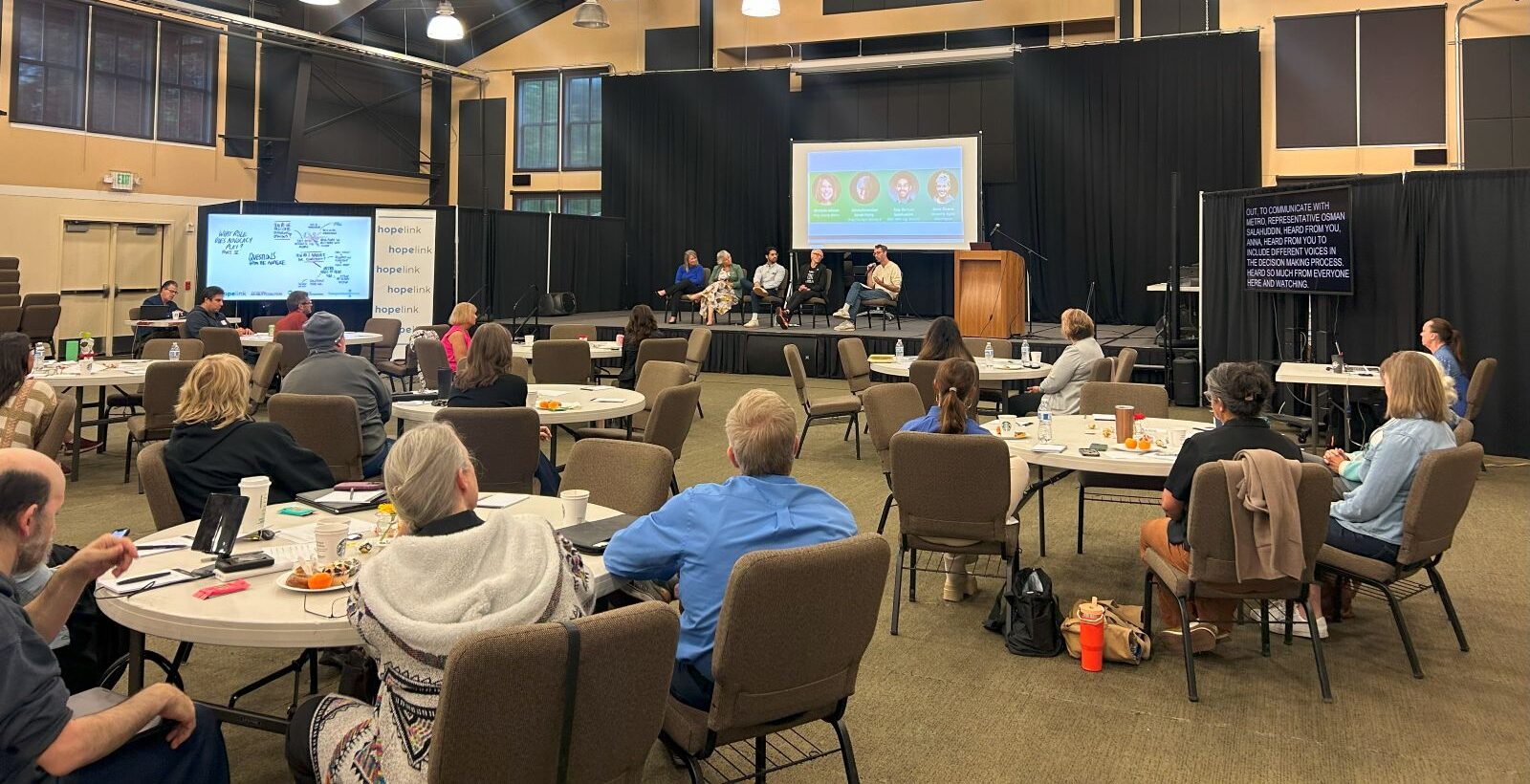
On June 13th, Transportation Choices Coalition, Hopelink, and the Snoqualmie Valley Mobility Coalition, with support from the Washington State Department of Transportation and the Rural Transit Assistance Program, hosted a Rural Transportation Advocacy 101 Workshop at the Riverview School District Assembly Hall in Duvall.
This event brought together over 40 local residents, elected leaders, and transit users united by a common goal: to strengthen rural transportation advocacy and improve mobility options in the Snoqualmie Valley region.
Rural communities face distinct transportation challenges, including limited transit service, gaps in pedestrian infrastructure, and fewer options for those who rely on safe, accessible public transportation. While these issues exist in urban areas as well, they often present differently in rural regions due to lower population density, longer distances between destinations, and fewer resources. The workshop emphasized that every piece of transportation infrastructure, from a bus stop to a crosswalk, exists because someone stood up and asked for it. This workshop aimed to equip attendees with the tools and confidence to become those advocates for their communities.
Inspiring Insights from Local Leaders
The day began with an engaging panel discussion featuring influential voices shaping transportation policy and advocacy in Washington:
● Michelle Allison, General Manager of King County Metro, provided an overview of current transit operations and shared Metro’s efforts to improve service in rural King County. She stressed the importance of community input in designing routes and schedules that reflect real-world needs.
● King County Councilmember Sarah Perry shared insights on local policymaking, budget limitations, and the essential role elected officials play in securing transportation investments that serve all communities, including rural and historically underserved areas.
● Representative Osman Salahuddin discussed the role of the Washington State Legislature in funding and supporting transit, and encouraged grassroots advocacy to influence decision-making at the state level.
● Anna Zivarts of Disability Rights Washington spoke on the intersection of transportation and disability justice, emphasizing that mobility justice means everyone, regardless of ability, should have access to reliable transportation and a seat at the table where decisions are made.
Together, the panel painted a powerful picture of how decisions get made at the local and state levels, and how community members can play a role in shaping them.
Check out the video of our inspiring panelists here:
Learning the Tools of Advocacy
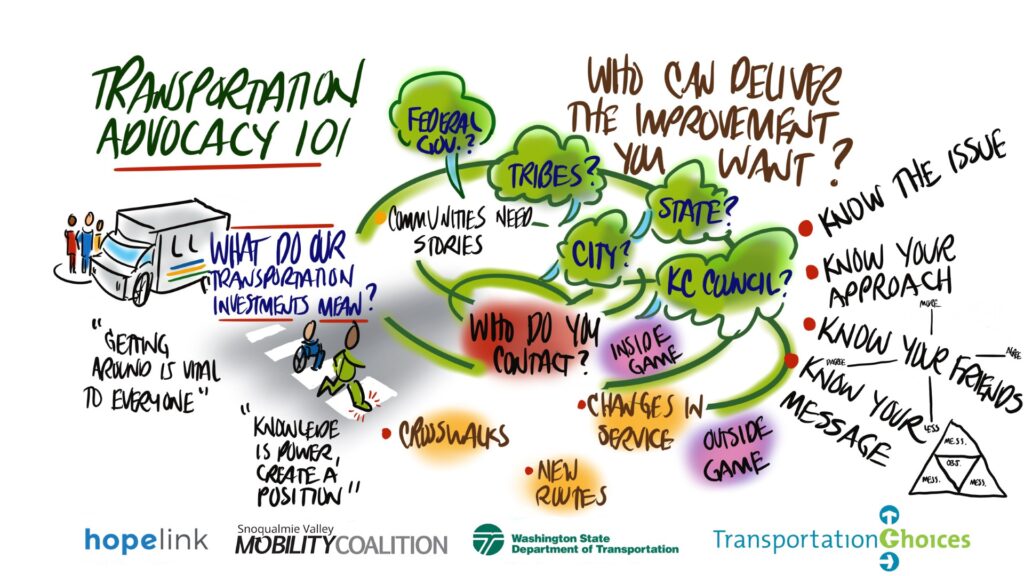
Graphic recorder diagram by Tim Corey of Colibri Facilitation
Following the panel, Kirk Hovenkotter led a training on effective advocacy strategies. He introduced foundational principles of advocacy, encouraging participants to begin by understanding their issue and clarifying their approach. The training emphasized the importance of identifying allies and champions, often through tools like power mapping, and shaping messages that resonate by using frameworks such as the messaging triangle. This tool helps advocates connect values, facts, and personal stories in ways that are compelling and tailored to different audiences. Participants were also encouraged to consider the most effective channels for delivering their messages, whether through direct meetings with decision makers, public testimony, media outreach, or working as part of a broader coalition. Throughout the session, the power of storytelling was a central theme, highlighting that impactful advocacy isn’t just about presenting data, but about linking it to real people and real experiences that illustrate why better transportation matters.
Advocacy in Action

Graphic recorder diagram by Tim Corey of Colibri Facilitation
The workshop culminated in a hands-on activity where participants put what they’d learned into practice by drafting mock public testimony advocating for expanded transit service in the Snoqualmie Valley. Several brave attendees stepped up to the microphone to share moving, personal stories about how current service limitations impact their families, neighbors, and livelihoods, highlighting barriers to employment, caregiving, community connection, and access to essential services. These testimonies brought the day’s lessons to life and emphasized the real impact of transportation policy.
Check out Kirk’s informative advocacy presentation and participants’ mock testimony here:
Building a Stronger, More Connected Community
The event was a powerful reminder that advocacy is an ongoing practice, rooted in relationships, persistence, and community voice. By offering practical tools, insight from experts, and space to practice new skills, the Snoqualmie Valley Rural Transportation Advocacy 101 Workshop supported local residents in building their capacity to speak up for improved transit. It demonstrated that better transportation systems don’t just happen; they’re the result of people coming together, sharing their stories, and advocating for solutions that reflect the needs of their communities.
Ride on!
– Transportation Choices